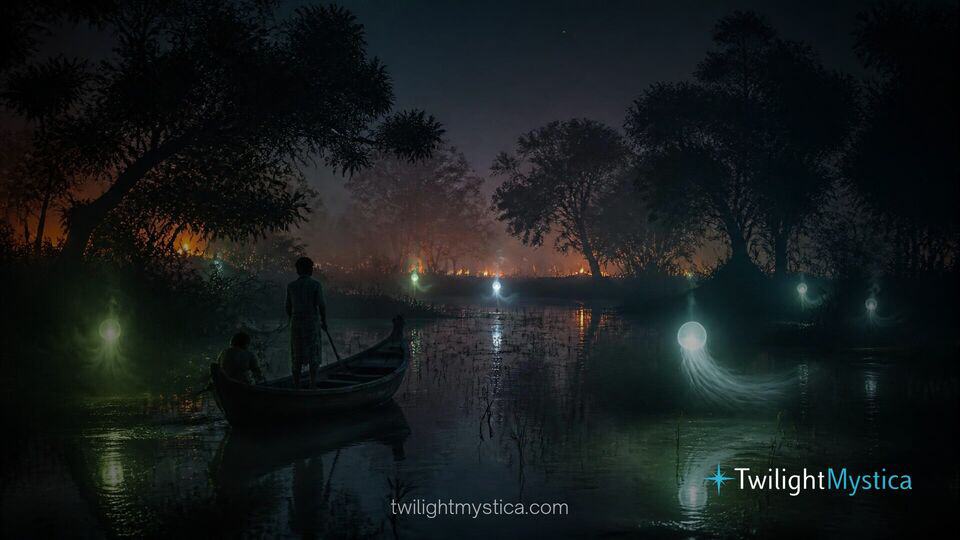
The Aleya ghost lights legend is one of the most intriguing pieces of folklore from Bangladesh. It describes mysterious glowing lights seen hovering above marshes, riverbanks, and wetlands, especially after dark. In village storytelling, these lights are often linked to restless spirits of those who died in the water, luring fishermen and travelers away from safe paths. To some, Aleya is a warning. To others, it is a haunting mystery. And to modern readers, it is also a fascinating example of how folklore and natural observation can exist side by side.
What makes the legend so enduring is that it grows from a real landscape. Bangladesh is shaped by rivers, lowlands, estuaries, and waterlogged fields. In such places, mist, darkness, reflected light, and swamp gases can turn the ordinary into something uncanny. The result is a story that feels both supernatural and believable, much like seeing a distant lantern moving where no person seems to stand. That blend of fear, environment, and imagination has helped Aleya remain a powerful part of rural lore.
Origins of the Aleya Ghost Lights in Bengali Wetlands
The word Aleya is commonly used in Bengali folklore to describe ghostly lights over wetlands. These lights are usually said to appear in lonely marshes, muddy channels, and floodplains where visibility is poor and sounds travel strangely. In oral tradition, Aleya is not just a visual oddity. It is a presence, almost like the land itself is trying to speak through fire.
The setting matters. Wetlands are transitional places, neither fully land nor fully water. In folklore around the world, such in-between spaces often become homes for spirits, omens, and supernatural events. The Aleya ghost lights legend fits this pattern perfectly. A glowing light in a city street may seem explainable. The same light flickering over a silent swamp at midnight can feel deeply unsettling.
Folklore and Fisherman Tales of Ghostly Marsh Lights
Many traditional stories describe Aleya as the souls of drowned fishermen or travelers who never returned home. According to these tales, the lights drift just ahead of people at night, tempting them to follow. A fisherman who mistakes the glow for another boat's lamp may row off course. A traveler crossing a damp field may think a house or safe landing lies ahead, only to become lost in mud or deeper water.
This is one reason the legend remained practical as well as spooky. It served as a warning system wrapped in story. Elders could tell children and young fishermen, in effect, do not chase strange lights in the wetlands. In the same way a parent might use the image of a wolf to keep a child from wandering into the forest, the Aleya story discouraged risky movement in dangerous terrain.
An easy analogy is a misleading road sign in heavy fog. If you trust what you think you see without checking your surroundings, you may end up far from safety. In rural Bangladesh, Aleya became that misleading sign, but with a spiritual face.
Scientific Explanations and Bioluminescent Phenomena
While the legend is supernatural in tone, science offers several possible explanations for the sightings. One common theory involves gases such as methane and phosphine released by decaying organic matter in marshy environments. Under the right conditions, these gases may ignite or appear to glow, producing faint, shifting lights close to the ground.
Another possibility is atmospheric distortion. Wetlands often create layers of humidity, mist, and temperature variation that can bend or scatter light. A distant lantern, fishing boat, or settlement lamp may look closer, stranger, or as if it is floating. In some cases, naturally glowing organisms are also mentioned in broader discussions of mysterious lights, though swamp gas and optical effects are the more common explanations connected to Aleya.
These explanations do not necessarily destroy the power of the legend. Instead, they show how people interpret unusual experiences through the language available to them. Before scientific vocabulary was widely shared, a mysterious light over a swamp did not arrive as chemistry or atmospheric optics. It arrived as a story.
Dangers Associated with Aleya Lights in Local Mythology
In local mythology, Aleya is rarely harmless decoration. It is often connected to confusion, misdirection, and death. The lights are feared not because they attack directly, but because they tempt people into making fatal mistakes. This gives the legend a psychological edge. The danger comes from trust, curiosity, and isolation.
How Spectral Flames Lead Nighttime Travelers Astray
A recurring theme in the Aleya ghost lights legend is that the lights move away as a person approaches. That detail is important. It turns Aleya into a trap of pursuit. The victim believes safety or meaning lies just a little farther ahead. By the time they realize they have been deceived, they may be in deep marsh, tangled reeds, or dangerous current.
This part of the legend works as a useful metaphor beyond folklore. People still chase false signals in everyday life: a rumor that sounds true, a promise that looks easy, a shortcut that becomes a setback. Aleya represents the danger of following appearances without judgment. In that sense, it functions almost like a moral parable disguised as a ghost story.
Examples in storytelling often include lone boatmen, villagers returning after dusk, or laborers crossing lowlands after market hours. The lesson is consistent: if you are disoriented, tired, and in an unfamiliar place, your senses can betray you.
Encounters along Bangladeshi Swamps and Rivers
Because Bangladesh has countless rivers, backwaters, and seasonal flood zones, stories of Aleya are tied closely to everyday geography. Villagers may report seeing lights over silt banks, near reed beds, or above stagnant water. Some accounts say the light flickers blue or pale yellow. Others describe it as a wavering flame, like a lamp carried by invisible hands.
Whether or not each encounter has a supernatural source, the stories reflect real environmental hazards. Wet ground can collapse. Tides and currents can shift in darkness. Familiar routes can vanish after rain or flooding. In this way, Aleya serves as a narrative tool for mapping danger. Rather than listing hazards in technical language, communities passed down memorable stories that people would actually remember.
As a use case in cultural education, the legend helped encode survival knowledge. If you tell a teenager, “Wetlands are unstable at night,” they may forget. If you say, “Do not follow Aleya, because it leads the unwary into death,” the warning is harder to ignore.
Cultural Impact of Aleya in Modern Rural Lore
Even today, Aleya remains meaningful because it exists at the crossroads of belief, identity, and place. In modern rural lore, the story can still be told as a genuine haunting, a cautionary tale, or a cherished part of local heritage. It survives because it speaks to lived experience in watery landscapes where nature can feel beautiful and threatening at once.
The legend also has value for readers interested in comparative folklore. Aleya resembles other ghost-light traditions around the world, such as will-o'-the-wisp stories in Europe. That similarity shows that human beings often respond to mysterious natural phenomena in surprisingly similar ways. When people see unexplained light in lonely places, they frequently imagine intention behind it.
A Living Story Between Myth and Observation
What keeps Aleya compelling is that it does not sit neatly in one category. It is not just a superstition, and it is not only a scientific puzzle. It is a living story shaped by environment, fear, memory, and community. For some, the lights are spirits. For others, they are marsh gas, light refraction, or misidentification. For many, they are both: a natural event wrapped in cultural meaning.
That dual nature makes the legend especially useful in classrooms, cultural writing, and storytelling. It can be used to discuss folklore, ecology, risk perception, and oral tradition all at once. It is also a strong reminder that legends often emerge not from fantasy alone, but from repeated attempts to explain a difficult world.
Recap of the Aleya Ghost Lights Legend
The Aleya ghost lights legend endures because it combines mystery with practical wisdom. It tells of strange lights in the wetlands of Bangladesh, often believed to be spirits of the drowned or lost. It warns fishermen and travelers not to trust every glow in the darkness. And it invites scientific curiosity about marsh gases, atmospheric effects, and the strange behavior of light in wet landscapes.
In the end, Aleya is more than a ghost story. It is a cultural lens for understanding danger, grief, and uncertainty in a land shaped by water. Whether read as folklore, metaphor, or natural mystery, it continues to flicker in the imagination like a distant flame over the reeds.