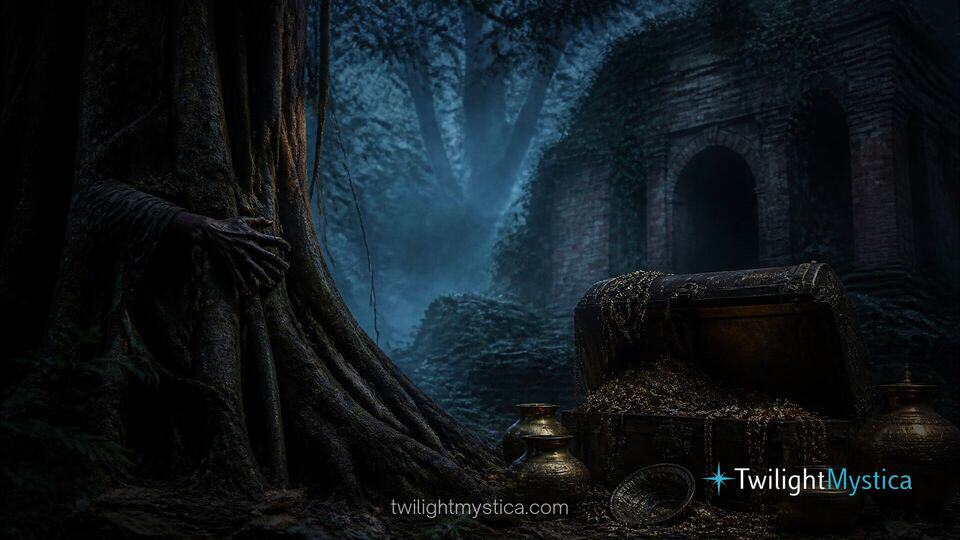
In Bengali folklore, few figures are as intriguing as the Jokkho treasure ghost, a supernatural guardian believed to watch over buried wealth, secret hoards, and cursed riches. The Jokkho occupies a fascinating space between spirit, mythic being, and moral warning. It is not simply a ghost in the modern horror sense, nor only a monster meant to frighten children. Instead, it represents a deep cultural idea: that wealth hidden from society often carries a price, and that greed can attract forces beyond human control.
Stories of Jokkho appear in oral traditions, village legends, family warnings, and regional storytelling across Bengal. In many tales, a Jokkho is tied to jokkher dhon, or treasure guarded under supernatural protection. Anyone who tries to claim that wealth without permission, ritual knowledge, or moral worthiness risks illness, madness, misfortune, or death. Because of this, the Jokkho is both a treasure keeper and a judge.
To understand the Jokkho, it helps to think of it as a mythic combination of a night watchman, a cursed lockbox, and a moral examiner. Like a guard dog chained to a hidden chest, it protects what lies underground. Like an enchanted contract, it reminds people that not every fortune is meant to be taken. And like a folktale judge, it exposes the motives of those who come seeking easy riches.
This article explores what the Jokkho is, where the legend comes from, how it behaves in folklore, and why its image still survives in modern Bengali language and imagination.
Origins of Jokkho in Traditional Bengali Mythology
The word Jokkho is often understood as a Bengali form related to older South Asian ideas of yaksha-like beings, supernatural entities associated with nature, riches, hidden places, and liminal spaces. Over time, Bengali folk belief gave the figure a more localized and eerie identity. In village imagination, the Jokkho became less a distant mythological class of beings and more a specific guardian spirit attached to buried treasure.
This transformation matters. In classical traditions, wealth-guarding beings could be majestic, ambivalent, or even divine servants. In Bengali storytelling, however, the Jokkho often became darker and more intimate. It was linked to abandoned land, old zamindar houses, ruined temples, giant trees, ponds, cremation grounds, and sealed earthen chambers. People did not merely speak of such a being in abstract terms; they pointed to places and said, “There is something there.”
The legend likely grew from several cultural layers working together:
- Ancient mythic beliefs about spirits connected to wealth and territory.
- Rural memory of hidden valuables buried during raids, war, debt, or social collapse.
- Moral storytelling that warned against greed, theft, and dishonest gain.
- Ritual thinking that treated land, inheritance, and valuables as spiritually charged.
In that sense, the Jokkho is not just a monster from a tale. It is also a cultural explanation for why sudden wealth feels suspicious, dangerous, or spiritually costly.
The Concept of Jokkher Dhon and Cursed Wealth
No discussion of the Jokkho is complete without understanding jokkher dhon, literally the treasure of the Jokkho. This phrase carries enormous symbolic weight in Bengali culture. It does not simply mean “hidden treasure.” It often suggests wealth that is inaccessible, enchanted, cursed, or protected by a force that does not tolerate casual possession.
Imagine finding a locked chest in an abandoned mansion. In an adventure film, opening it might bring reward. In a Bengali folk setting, opening it might bring a guardian spirit, a family curse, or a chain of disasters. That difference captures the emotional world of jokkher dhon. Wealth is not automatically a blessing. Unclaimed wealth may already belong to another order of reality.
Some folktales describe treasure buried with incantations. Others speak of spirit guardians assigned through dark rites. In still others, treasure can only be removed under exact conditions: at a specific lunar hour, after reciting mantras, or by someone who can withstand terrifying illusions. Gold coins may appear as burning embers. Jewels may vanish at sunrise. Snakes, strange lights, laughter, or phantom voices may erupt around a treasure site.
These details serve a purpose. They transform treasure into a test. The story is no longer about money alone. It becomes a question of character, purity, courage, and destiny.
Understanding the Jokkho Treasure Ghost in Folklore
The phrase Jokkho treasure ghost captures the folk image well because the being is often treated less like a god and more like a haunting presence. Yet it differs from the wandering dead. A wandering ghost drifts because something is unresolved. A Jokkho stays because it has a duty.
This distinction is useful. If an ordinary ghost is like a lost traveler, a Jokkho is like a stationed sentinel. It is rooted to a treasure site, an old estate, a ruin, or a sealed patch of earth. Its power comes from attachment and obligation.
Descriptions vary from region to region. In some stories, the Jokkho is invisible and known only through signs: sudden cold, eerie lights, unusual sounds, or paralysis in those who approach hidden wealth. In other tales, it takes on forms that terrify intruders: a dwarf-like figure, a skeletal guardian, a glowing-eyed watcher, or even an animal form such as a snake. Folklore often leaves the appearance unstable, which makes the spirit more frightening. What matters is not its fixed shape, but its function as a protector and deterrent.
The Jokkho also differs from a simple villain. It is not always evil in the straightforward sense. Instead, it enforces boundaries. If treasure is buried under vow, sin, bloodshed, or secrecy, the Jokkho becomes the keeper of that boundary. In many tales, the spirit punishes trespass, not because it loves cruelty, but because the treasure is not freely available to human desire.
Behaviors and Guardian Duties of the Treasure Spirit
The Jokkho’s role as a guardian spirit defines its behavior in Bengali legend. It does not roam randomly looking for victims. It watches, warns, confuses, and punishes when someone comes too close to protected riches.
Several recurring duties appear in folk narratives:
- Guarding the location of buried wealth from thieves and fortune seekers.
- Concealing treasure through illusion, fear, or supernatural misdirection.
- Testing the intruder to judge motive, bravery, ritual fitness, or greed.
- Defending an oath or curse attached to the treasure’s original burial.
In many ways, the Jokkho functions like a folkloric security system. But instead of alarms and steel doors, it uses dread, deception, and spiritual force. A digger may hear footsteps behind him. A torch may blow out without wind. A person may become irrationally frightened and flee. Someone who ignores the warnings may later suffer fever, nightmares, or financial ruin.
These episodes reinforce a core lesson: forbidden wealth rarely stays profitable. Even if treasure is taken, it may not remain with the thief. Coins disappear. Families fall into conflict. Unexpected loss follows sudden gain. The guardian’s power extends beyond the excavation itself.
Protecting Hidden Hoards and Testing Intruders
One of the most interesting features of Jokkho tales is that the spirit often tests people rather than merely attacks them. This gives the stories moral complexity. The person seeking treasure is not always innocent. Sometimes he is desperate, but often he is impatient, dishonest, or greedy.
A common pattern goes like this: someone hears rumors of buried riches under a banyan tree, beside a pond, or beneath the floor of an old house. A ritual specialist, elder, or wandering ascetic warns that the treasure is guarded. The seeker ignores the warning. Strange signs begin. Perhaps the ground seems to move. Perhaps a snake appears and vanishes. Perhaps laughter echoes in the dark. If the seeker persists, disaster follows.
But in some versions, restraint is rewarded. A person who refuses to steal, who performs proper rites, or who seeks only what is necessary may be spared. This makes the Jokkho similar to a stern examiner. It is less like a random horror creature and more like a keeper of rules that humans do not fully understand.
Why the Test Matters
Folklore often uses supernatural guardians to dramatize internal human flaws. The Jokkho externalizes temptation. Instead of saying “greed destroys people,” the story says, “the treasure had a guardian, and it destroyed the greedy man.” The lesson lands more powerfully because it becomes vivid and memorable.
This is why the Jokkho remains compelling even today. It gives a face to the danger of wanting shortcuts to fortune.
Cultural Legacy and Idioms in Modern Bengali Language
The Jokkho survives not only in stories of haunted treasure but also in Bengali speech and imagination. References to jokkher dhon are still used metaphorically to describe something carefully guarded, difficult to access, or treated as too precious to share. A person might jokingly compare someone’s hidden savings, secret stash, or overprotected possession to jokkher dhon.
This metaphorical life is important because it shows how mythology becomes language. Many legendary beings fade when people stop believing in them literally. The Jokkho, however, persists because it expresses a familiar human reality: people guard what they value, and the more secret the treasure, the more powerful the aura around it.
The legend also remains useful in literature, cinema, comics, and storytelling because it combines several timeless themes:
- Greed versus restraint
- Wealth versus moral cost
- Curiosity versus taboo
- Inheritance versus trespass
In modern terms, the Jokkho can be compared to a password-protected vault with a curse attached. You can try to break in, but the real question is whether what you gain will ever truly become yours. That analogy helps explain why the figure still feels relevant. The outer form is folkloric, yet the underlying idea remains universal.
Why the Jokkho Still Fascinates Readers Today
The enduring power of the Jokkho comes from its layered meaning. On the surface, it is an eerie treasure guardian. Beneath that, it is a cultural memory of hidden wealth and unstable history. Deeper still, it is a moral symbol warning that possession is not the same as deserving.
For readers interested in mythology, the Jokkho offers a window into how regional folklore reshapes older spiritual concepts into local narrative forms. For fans of ghost stories, it provides haunting atmosphere without losing symbolic depth. And for cultural observers, it reveals how communities encode economic anxiety, social memory, and ethical caution into supernatural tales.
That blend is rare. The Jokkho is scary, but it is also thoughtful. It frightens, yet it teaches.
Recap: The Meaning Behind the Jokkho Legend
The Jokkho treasure ghost is one of Bengali folklore’s most memorable supernatural figures: a spirit-like guardian tied to hidden wealth, cursed treasure, and moral testing. Rooted in older South Asian ideas of wealth-bearing beings and transformed through Bengali folk imagination, the Jokkho became the keeper of jokkher dhon, treasure too dangerous to claim lightly.
Its stories emphasize more than fear. They explore secrecy, desire, inheritance, taboo, and the hidden cost of greed. Whether imagined as an invisible presence, a frightening guardian, or a metaphor for overprotected riches, the Jokkho continues to live in language and legend alike.
In the end, the Jokkho reminds us of a lesson found in many cultures but expressed in a distinctively Bengali way: the most tempting treasure may be the one that demands the greatest sacrifice, and not every buried fortune is meant to be unearthed.