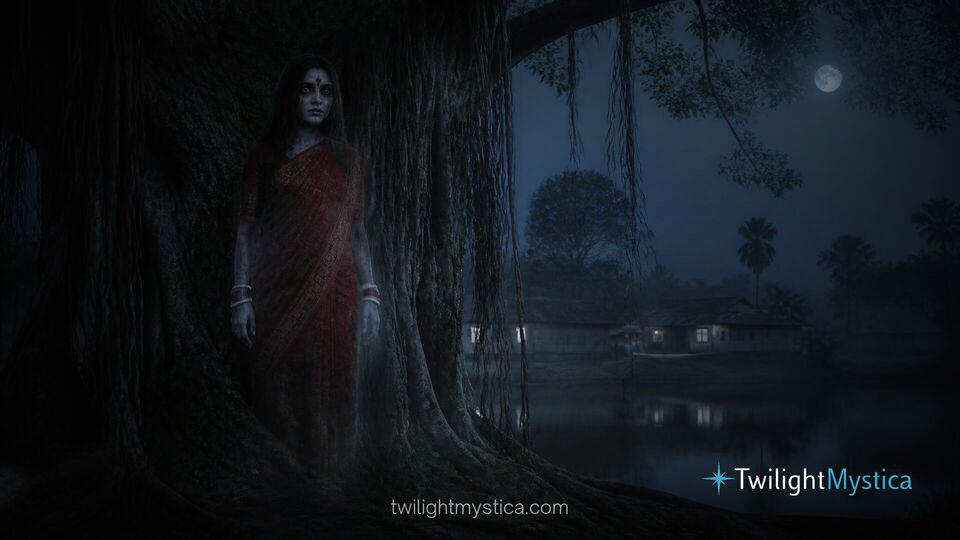
The Shakchunni spirit legend is one of the most recognizable ghost tales in Bengali folklore. More than a simple scary story, it reflects beliefs about marriage, identity, loss, and the unseen world. In traditional lore, a Shakchunni is the spirit of a married woman who died before her desires, duties, or attachments to domestic life were resolved. She is usually described as wearing the signs of marriage, especially white conch-shell bangles and red-bordered clothing, which makes her both familiar and unsettling.
What makes this figure so memorable is the contrast at its core. A married woman is often associated with prosperity, household continuity, and ritual auspiciousness. Yet in this legend, those same symbols return in ghostly form. The result is a spirit who seems to belong to the home, but whose presence signals disorder. Much like the image of a smiling portrait with eyes that seem to follow you, the Shakchunni appears ordinary at first, then slowly turns uncanny.
This article explores the origins, imagery, behaviors, and cultural uses of the Shakchunni in Bengali storytelling. It also explains why the figure remains powerful in oral tales, literature, and modern horror retellings.
Origins and Identity of Shakchunni in Bengali Folklore
In Bengali folk belief, the Shakchunni is generally understood as the ghost of a married Hindu woman. The name itself is closely linked to shankha, the white conch-shell bangles traditionally worn by married women in Bengal. Because of this, her identity is not vague or abstract. It is marked by social status, ritual signs, and unfinished worldly attachment.
Unlike many ghosts that are simply wandering dead, the Shakchunni spirit legend gives the spirit a very specific emotional and social background. She is often imagined as someone whose life was interrupted abruptly, whether by tragedy, neglect, betrayal, illness, or untimely death. Folklore suggests that her desires do not disappear with death. Instead, they harden into longing. That longing may be for her husband, for domestic authority, for adornment, or for the life she believes was taken from her.
One useful analogy is to think of the Shakchunni as a story about unfinished identity. If a person is remembered by a role so strongly that the role outlives the person, folklore transforms that memory into a haunting figure. In this way, the Shakchunni is not just a ghost. She is the echo of a social role that refuses to fade.
Symbolism of Shankha Shell Bangles and Red Attire
The most striking features of a Shakchunni are her marital ornaments. The shell bangles, vermilion, and red-bordered sari are not random costume details. In Bengali culture, these items traditionally signify married status, continuity, and auspicious womanhood. Their presence on a ghost turns comfort into dread.
This reversal is essential to the legend. Folk narratives often create fear by distorting familiar things. A deserted courtyard at noon, anklets heard in an empty room, or a bride-like figure appearing near a pond at dusk are all frightening because they twist everyday domestic imagery into something unnatural. The Shakchunni works in exactly this way.
For listeners, these symbols act almost like visual shorthand. The moment the bangles are mentioned, the audience knows this is not merely a female ghost. It is a spirit tied to marriage, ritual identity, and the household sphere.
Distinct Differences Between Shakchunni and Petni
People sometimes confuse the Shakchunni with the Petni, another female ghost in Bengali lore, but the two are distinct. A Petni is commonly portrayed as the spirit of an unmarried woman or a more generally restless female dead. Her appearance and motives vary more widely across regions and stories.
The Shakchunni, by contrast, is much more specifically coded. She is tied to the symbols and expectations of marriage. If the Petni can be compared to a broad ghost category, the Shakchunni is a highly defined subtype with a clear visual identity.
This distinction matters because folklore thrives on categories. Just as modern stories separate vampires, witches, and banshees, Bengali oral tradition distinguishes spirits by origin, temperament, and signs. Knowing the difference helps readers understand that the Shakchunni spirit legend is not generic horror. It is culturally precise.
Shakchunni Spirit Legend and Its Cultural Meaning
At a deeper level, the legend expresses anxieties about gender roles, domestic expectations, and the fragility of social order. In many traditional settings, a married woman was closely tied to the honor and rhythm of the household. Her clothing, jewelry, and ritual status signaled stability. When folklore imagines that figure returning as a spirit, it suggests that instability has entered the very center of domestic life.
This is why the Shakchunni is often associated with liminal spaces rather than wild, distant places alone. She may appear near ponds, village paths, banyan trees, empty courtyards, or the edges of homes. These are threshold locations, neither fully safe nor fully forbidden. They mirror her own condition: she belongs neither fully to the world of the living nor fully to the world of the dead.
Stories like these also served practical uses in village life. They warned people not to wander alone at night, not to approach isolated water bodies after dark, and not to ignore ritual obligations surrounding death and remembrance. In that sense, the legend functioned like a cultural safety system wrapped in supernatural language.
Haunting Patterns and Possession Beliefs in Rural Lore
In many oral accounts, the Shakchunni does not merely appear and vanish. She lingers, imitates, and intrudes. Some tales describe her as lurking near homes, especially where married women live. Others claim she can influence the mind, drain vitality, or attempt possession. The emphasis is often less on violent attack and more on unsettling replacement.
For example, a common storytelling pattern involves a woman behaving strangely after returning from a lonely pond, grove, or path at twilight. She may speak in an unfamiliar tone, develop unusual cravings, or display knowledge she should not possess. The fear here is intimate. It is not the fear of a monster outside the door, but of something crossing into the family itself.
An analogy from modern storytelling would be the “imposter” theme, where someone looks familiar but no longer feels like themselves. The Shakchunni embodies that same unease in a rural folkloric framework.
Why Shakchunni Targets Married Household Women
One recurring belief is that the Shakchunni is especially drawn to married women because they embody the life and status she has lost. In folklore, spirits often desire what they lack, and the Shakchunni’s lack is deeply specific. She is not just dead; she is cut off from the role that defined her social identity.
This helps explain why stories portray her as envious, imitative, or possessive. She may seek ornaments, domestic space, attention from a husband, or symbolic access to the household. In narrative terms, this creates a powerful emotional conflict. The living woman represents continuity, while the ghost represents interruption. The haunting becomes a struggle over place, recognition, and belonging.
As a use case in storytelling analysis, this legend is especially useful for understanding how folk horror converts social pressure into supernatural drama. What could have been discussed as grief, insecurity, or lost status instead appears as a haunting presence.
Traditional Remedies and Folk Exorcism Beliefs
Folk traditions surrounding the Shakchunni often include remedies, protections, and exorcism practices. These vary by region, but they commonly involve priests, mantras, ritual purity, iron objects, sacred ash, or protective charms. In some stories, identifying the spirit’s true nature is the first step toward removing its hold.
These remedies matter because they complete the logic of the legend. A culture that tells stories of haunting usually also tells stories of defense. The fear is balanced by a method of response. This makes the legend socially useful: it does not merely produce anxiety, it also reinforces trust in ritual specialists, household customs, and communal belief.
From a modern perspective, these practices can also be read symbolically. Ritual intervention gave communities a structured way to respond to unexplained distress, whether emotional, social, or physical. Even when viewed outside literal belief, the pattern shows how folklore helps people manage uncertainty.
Why the Shakchunni Still Fascinates Today
The Shakchunni remains compelling because she stands at the meeting point of horror and social meaning. She is visually vivid, emotionally layered, and deeply rooted in regional culture. Unlike a faceless ghost, she arrives with identity, memory, and symbolism already attached.
Modern readers, filmmakers, and horror fans continue to revisit her because the legend offers more than fear. It explores what happens when roles become prisons, when longing survives death, and when the familiar turns strange. The Shakchunni spirit legend endures for the same reason many great folk tales endure: it can be read as a ghost story, a warning, a social mirror, or all three at once.
Recap: Understanding the Shakchunni Spirit Legend
The Shakchunni is a married female spirit from Bengali folklore, recognized by symbols such as shell bangles, vermilion, and red attire. Her legend is shaped by unfinished desire, attachment to married identity, and a haunting connection to domestic life. Unlike the Petni, she is specifically associated with marriage and household symbolism.
Across rural lore, she is said to haunt threshold spaces, target married women, and sometimes attempt possession or symbolic replacement. Traditional remedies involve ritual protection and folk exorcism, showing how the stories offered both fear and a framework for control. Ultimately, the Shakchunni is more than a ghost. She is a cultural figure through which Bengali folklore reflects on marriage, memory, status, and the uncanny power of the familiar.