Skondhokatah headless ghost is one of the most unsettling figures in Bengali folklore: a spirit said to roam after death without its head, often linked to violent endings, lonely places, and unfinished business. In rural storytelling across Bengal and Bangladesh, Skondhokatah is not merely a monster meant to scare children at night. It is also a cultural symbol of sudden death, social anxiety, and the fear that a disturbed soul may fail to cross peacefully into the next world.
Like many legendary spirits, Skondhokatah sits at the crossroads of belief, cautionary tale, and communal memory. Some descriptions portray it as a wandering apparition searching for its missing head. Others present it as dangerous and deceptive, luring travelers on dark roads, near trees, marshes, or railway tracks. The image is vivid and unforgettable: a human-shaped ghost made more horrifying by absence itself.
This explainer breaks down what Skondhokatah is, where the legend likely comes from, why the headless form matters, and how the figure continues to appear in modern ghost storytelling. Think of it as part folklore study, part horror archetype, and part social mirror reflecting what a community fears most.
The Legend of Skondhokatah in Rural Bengal Lore
In village-based oral tradition, Skondhokatah is often described as the ghost of someone who died through beheading, mutilation, or another unnatural and violent circumstance. Folklore across South Asia frequently treats improper death as spiritually dangerous. When the body is broken, burial rites are disrupted, or the person dies suddenly with intense emotion, the soul is imagined as unable to rest.
That belief gives Skondhokatah its basic logic. The ghost is terrifying not only because it lacks a head, but because the missing head signals disorder. In folklore, the body should be whole, rituals should be complete, and death should be acknowledged by the community. When those things fail, a haunting begins.
An easy analogy is a story with its final chapter torn out. Everything before it happened, but the ending never settled. Skondhokatah embodies that missing ending. The spirit remains trapped between worlds, and its form shows that rupture for all to see.
In practical storytelling terms, villagers may use the legend to explain why certain places feel dangerous after dark. A lonely crossing, a grove at the edge of a field, or a rail line where accidents happened can become attached to the tale. Once a place gains such a reputation, each retelling makes the haunting stronger.
How Unnatural Beheadings Create Headless Spirits
Folklore often links supernatural disturbance to violent death because such deaths are emotionally and socially disruptive. A person killed by accident, murder, war, or punishment leaves behind shock, grief, and unanswered questions. In the case of Skondhokatah, beheading becomes the ultimate sign of spiritual interruption.
The missing head carries several meanings at once. It suggests loss of identity, because the face is how people are recognized. It suggests loss of speech, because the dead cannot tell their story. It also suggests loss of direction, as if the spirit cannot see the path forward. This layered symbolism helps explain why the legend remains powerful even for people who do not literally believe in ghosts.
For example, if a community once witnessed a gruesome death near a transport route, the memory might survive as a supernatural warning: do not travel recklessly, do not mock the dead, and do not assume every path is safe simply because it is familiar. In that sense, the ghost functions like a moral road sign wrapped in horror.
Behaviors and Spectral Attacks on Railway Tracks
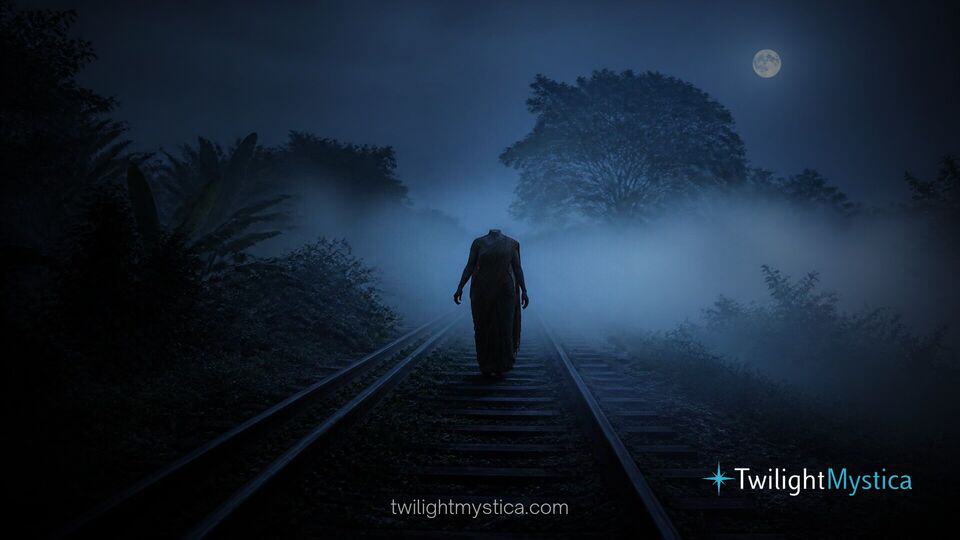
One of the most chilling details associated with Skondhokatah in later ghost storytelling is its presence near railway tracks. This setting makes cultural sense. Railway lines are liminal spaces: they connect places, cut through villages, and are associated with both modern movement and sudden death. Folklore often thrives in such in-between zones.
Stories describe the spirit appearing to solitary walkers at night, startling them into panic, or confusing their sense of direction. In some versions, it calls out for help. In others, it rushes toward the victim or creates the impression of an oncoming danger. Whether or not listeners take these accounts literally, the narrative use case is clear: the legend warns people away from isolated tracks, especially after dark.
Imagine how urban legends today spread around abandoned tunnels or empty highways. Skondhokatah works in a similar way. The ghost story transforms a risky environment into a memorable cautionary map. Instead of saying, “Do not walk alone on the tracks at night,” folklore says, “A headless spirit wanders there.” The second version is far harder to forget.
Understanding the Skondhokatah Headless Ghost as Symbol and Warning
The Skondhokatah headless ghost is frightening because it combines visual horror with emotional unease. A skeleton may be spooky, but a headless human form feels wrong in a more immediate way. It resembles a person enough to be recognizable, yet the missing head destroys normal human order.
This makes the legend effective on several levels. First, it is a horror image. Second, it is a social warning about dangerous places and violent acts. Third, it can express grief that a community has not fully processed. A headless ghost is a way of saying that something terrible happened and the world still feels broken because of it.
There is also a broader folkloric pattern here. Many cultures have figures defined by a bodily absence or distortion: faceless spirits, shadow people, or revenants with visible wounds. These beings externalize fear. Skondhokatah does this through decapitation, turning physical incompleteness into spiritual unrest.
Why the Missing Head Matters So Much
In storytelling, the head represents memory, personality, voice, and intention. Remove it, and what remains is movement without identity. That is deeply uncanny. It is similar to hearing footsteps in an empty room: the familiar is present, but the source is wrong. Skondhokatah magnifies that feeling.
This may be why the figure remains so memorable in oral tradition and modern retellings alike. It is simple, striking, and symbolic all at once.
Surviving an Encounter with Skondhokatah
Traditional stories about surviving Skondhokatah vary, but they often follow familiar protective patterns found in regional ghost lore. People are warned not to respond casually to strange calls at night, not to travel alone through feared places, and not to panic if something uncanny appears. The cultural logic is that fear makes a person vulnerable, while composure offers some protection.
In some tellings, prayer, recitation of sacred words, or invoking divine protection helps ward the spirit off. In others, respecting the dead is the true safeguard. That means avoiding mockery, observing funeral customs, and staying away from sites associated with violent death.
These stories have clear everyday use cases. Elders may tell them to children and young adults to discourage nighttime wandering. Communities may repeat them after accidents as a way to impose caution and meaning on tragedy. Even skeptical listeners often remember the rule if not the belief.
Local Myths on How the Headless Ghost Seeks Help
Not every version of Skondhokatah is purely malicious. Some legends suggest the spirit seeks help locating its head, completing its rites, or receiving acknowledgment from the living. This gives the figure a tragic dimension. The ghost is terrifying, but it may also be pitiful.
That dual nature is common in folklore. A spirit can be both victim and threat. If ignored, it becomes dangerous; if properly recognized, it may finally rest. This idea adds emotional depth to the legend and helps explain why Skondhokatah remains more than a simple jump-scare character.
The Role of Skondhokatah in Modern Bangladeshi Ghost Stories
Today, Skondhokatah continues to survive through horror fiction, online storytelling, local retellings, and discussions of regional folklore. Modern versions may place the ghost near train stations, highways, or semi-urban edges rather than only deep village spaces. Yet the core image stays the same: a headless presence tied to violent death and unresolved passage.
In that way, the legend adapts without disappearing. It moves with changing landscapes while preserving older fears about restless spirits, dangerous travel, and deaths that society cannot easily absorb. Like other enduring ghost figures, Skondhokatah remains relevant because it can be retold in new settings without losing its original dread.
Recap: Why Skondhokatah Still Haunts the Imagination
Skondhokatah is more than a frightening Bengali ghost. It is a folklore figure shaped by ideas about unnatural death, incomplete ritual, memory, danger, and social warning. Its headless form is not random horror decoration; it symbolizes a life cut short and a soul denied closure.
Whether understood as belief, metaphor, or ghost-story tradition, the Skondhokatah headless ghost remains compelling because it does several things at once. It terrifies, instructs, and remembers. It warns travelers away from risky places, gives communities a language for trauma, and turns the fear of violent death into a legend that still feels vivid today.
That is the lasting power of Skondhokatah: it is not just a ghost without a head, but a story about what happens when death itself seems unfinished.