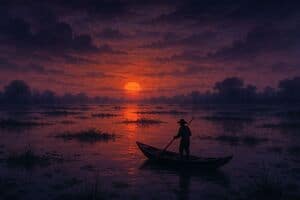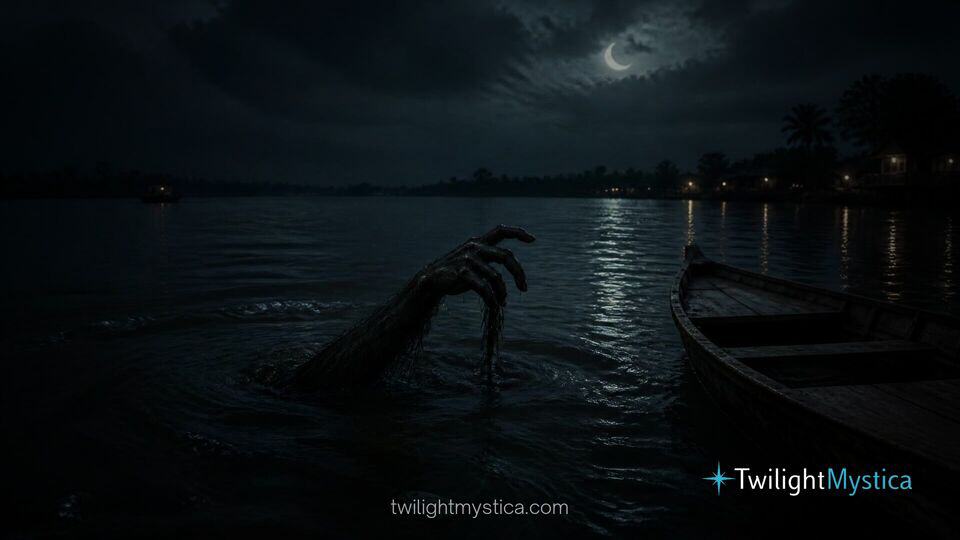
In Bengali folklore, rivers are never just rivers. They feed villages, shape travel, flood fields, swallow paths, and inspire stories that move between warning and wonder. Within that landscape appears the Joldano water spirit legend, a riverine tale about a mysterious being linked to deep waters, ponds, marshes, and dangerous currents. Whether imagined as a ghostly presence, a supernatural lure, or a spirit attached to drowning places, Joldano belongs to a wider tradition in which nature is treated as alive, watchful, and morally charged.
At its core, Joldano can be understood as a folkloric explanation for the fear people feel around unstable water. In places where riverbanks collapse without warning and village ponds can turn deadly in the monsoon, a spirit story gives danger a face. Much like a caution sign placed by oral tradition rather than by a government office, the legend teaches listeners to respect certain places and behaviors.
This makes Joldano more than a spooky character. It is also a cultural tool. The story can frighten children away from deep water, caution travelers against wandering alone at dusk, and help communities express grief around unexplained drownings. In that sense, the spirit works almost like folklore’s version of a public safety message, wrapped in eerie imagery that people remember for years.
Origins of Joldano in Bengali Riverine Lore
The likely roots of Joldano lie in Bengal’s intimate relationship with water. Across Bengal and Bangladesh, rivers, canals, bils, ponds, and floodplains have shaped everyday life for centuries. Fishing, ferry travel, bathing, irrigation, and monsoon survival all depend on reading the moods of water. In such an environment, it is natural for oral traditions to imagine water as inhabited by unseen beings.
Joldano seems to fit into a broad family of Bengali supernatural figures tied to specific landscapes. Just as groves, bamboo clusters, crossroads, and cremation grounds gain their own spirit lore, deep or silent waters gain entities of their own. The logic is simple: a dangerous place invites a memorable guardian, hunter, or deceiver in story. The spirit becomes a narrative shorthand for risk.
As a use case, imagine a village child asking why one pond is avoided while another is used daily. Rather than giving a lecture on hidden depth, weeds, mud suction, and seasonal currents, an elder may say that Joldano waits there. The explanation is vivid, portable, and emotionally effective. Folklore often survives because it teaches in ways technical language cannot.
This pattern appears across Bengali lore, where supernatural stories attach themselves to lived environments. Readers interested in similar place-bound beings may also explore the Gecho Bhoot tree ghost or the Besho Bhoot bamboo spirit, both of which show how landscape and legend often grow together.
Physical Descriptions and Powers of Water Spirits
Like many oral folklore figures, Joldano does not have a single fixed appearance. In one retelling, it may be a shadowy humanoid shape glimpsed near reeds. In another, it may be heard more than seen: splashing where no one stands, whispering from dark water, or calling in a familiar voice to lure the unwary closer. This flexibility is common in folklore because the spirit adjusts to local fears.
Some descriptions present such water beings as pale, drenched, and half-visible under moonlight. Others imagine long hair drifting over the water’s surface, glowing eyes in the dark, or a body that seems to rise and sink without disturbing the current. These features matter not because they are consistent, but because they create a mood: uncertainty. Joldano is frightening in the way deep water is frightening—you rarely know what is truly beneath the surface.
Its powers are also symbolic. A Joldano-like spirit may confuse direction, imitate a loved one’s voice, pull at a person’s feet, or create the illusion of safety where danger actually lies. As an analogy, it functions much like quicksand in adventure fiction: not always encountered literally, but effective as a dramatic image of hidden threat. In practical terms, these supernatural powers mirror real hazards such as slippery banks, sudden drop-offs, exhaustion while swimming, or disorientation during storms.
Rural Warnings Surrounding Deep Rivers and Ponds
One of the clearest functions of the Joldano story is preventive. Rural communities have long used folklore to establish informal safety rules. Do not bathe alone at dusk. Do not cross flooded ground after heavy rain. Do not answer strange calls from the riverbank at night. Do not mock places where deaths have occurred. Through legend, each rule gains emotional force.
In this way, the Joldano water spirit legend acts like a spoken hazard map. It helps people remember where the dangerous embankment is, which pond has a history of accidents, and why children should stay close to adults during monsoon season. A modern reader might compare this to urban legends about abandoned buildings or dangerous roads: the story dramatizes a risk so the warning sticks.
There is also a social dimension. If someone drowns in confusing or tragic circumstances, a spirit explanation can give shape to communal grief. Instead of accepting random loss, people say the place was troubled, claimed, or inhabited. That does not make the explanation scientific, but it does make it meaningful. Folklore often answers emotional questions before it answers factual ones.
Social and Cultural Impact of Water Demon Myths
Water-spirit legends influence more than fear. They shape habits, conversation, and local identity. Villages known for deep ponds or treacherous channels may develop stories that become part of how outsiders perceive them. Fishermen, boatmen, and children inherit not just techniques for navigating water, but also a vocabulary of respect. That mixture of practical knowledge and myth is one reason such legends remain memorable.
These stories also reveal how communities personify the natural world. Instead of treating nature as empty scenery, Bengali folklore often imagines it as occupied and responsive. A river can bless, punish, conceal, or deceive. Joldano therefore stands at the crossroads of ecology and imagination. The spirit is not separate from the river; it is a narrative expression of the river’s unpredictability.
In literary and cultural terms, these myths preserve local ways of seeing. They record a world in which survival depends on attention to season, depth, sound, and weather. Telling a child that a spirit dwells in black water may sound superstitious from the outside, but within the community it can function as compressed environmental wisdom.
Reflecting River Hazards in Traditional Storytelling
Traditional storytelling often turns abstract dangers into memorable characters. That is exactly what happens with Joldano. A strong current is invisible; a spirit pulling downward is unforgettable. A muddy bank seems ordinary; a haunted edge becomes a place everyone remembers to avoid. Through this transformation, storytelling converts environmental risk into shared social knowledge.
Consider how this works in practice. If elders say a certain bend in the river “takes people,” younger listeners may remember that phrase longer than a technical explanation about undercurrents. Folklore compresses data into image. The image may be supernatural, but the behavior it encourages can be practical: caution, group travel, and respect for local experience.
This is similar to how folktales elsewhere warn against the forest, mountain passes, or open sea. The setting changes, but the function stays the same. Joldano is Bengal’s river warning cast in mythic form.
Joldano Compared to Other Bengal Wetland Ghosts
Joldano becomes easier to understand when compared with other Bengali supernatural traditions. Some spirits haunt trees, some bamboo groves, some roads, and others wetlands or fishing grounds. In wetland-related folklore, atmospheric mystery often matters as much as the creature itself: mist, reflected light, echoing calls, and uncertain footing all contribute to the fear.
For example, the eerie uncertainty surrounding Aleya ghost lights in Bangladeshi wetlands also grows out of hazardous terrain and disorienting natural conditions. Likewise, readers may notice thematic overlap with the Mechho Bhoot fish-stealing spirit, which connects folklore to watery livelihoods and daily village life. If you are interested in legends focused on haunted water sites more specifically, the Shahidullah Hall pond ghost story offers another example of how ponds become centers of supernatural memory.
What sets Joldano apart is its role as a distinctly riverine danger figure. It embodies not just haunting, but the pull of water itself: depth, current, silence, and sudden loss. That makes it less like a house ghost and more like a mythic force attached to place.
Why the Joldano Water Spirit Legend Still Resonates
The legend still matters because the emotions behind it remain familiar. People continue to fear what they cannot see beneath the waterline. Communities still tell stories to protect children. Sudden deaths still generate narratives that seek meaning beyond accident. Even in a modern context, Joldano survives as a powerful metaphor for hidden danger.
It also resonates because it preserves Bengali river culture in symbolic form. To study Joldano is to study how people lived with waterways—not as tourists, but as dependents, workers, travelers, and mourners. The spirit becomes a cultural memory of that intimate relationship.
For writers, educators, and folklore enthusiasts, Joldano offers a useful example of how myth works. It explains, warns, dramatizes, and remembers all at once. Like a lantern reflected on dark water, the story reveals just enough to guide the listener while leaving much of the depths unknown.
Summary
The Joldano water spirit legend is best understood as a Bengali folklore tradition rooted in the dangers and mystery of rivers, ponds, and marshy waters. It represents more than a frightening being. It serves as a warning system, a grief narrative, and a symbolic way of describing environments that can sustain life one season and take it away the next. Through shifting descriptions, rural cautionary tales, and cultural memory, Joldano reflects the deep bond between Bengali communities and the waters around them. In that sense, the legend endures not only because it is eerie, but because it is useful, memorable, and profoundly tied to place.