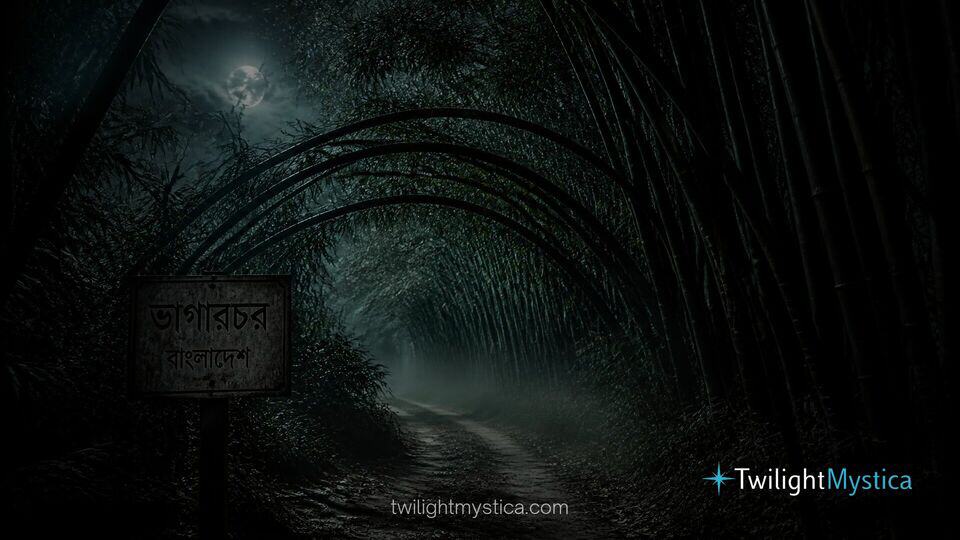
Among the many spirits described in Bengali folklore, the Besho Bhoot bamboo ghost stands out for its close link to the landscape. This is not a ghost imagined in a ruined palace or a cremation ground alone. Instead, it belongs to the rustling edges of village life: bamboo clumps, narrow footpaths, shadowy groves, and places where moonlight barely reaches the ground. In oral tradition, Besho Bhoot is a spirit associated with bamboo thickets, especially those that seem unnaturally still by day and unsettlingly alive at night.
In stories told across rural Bengal and Bangladesh, the ghost is often described as a deceptive force that confuses passersby, frightens lone travelers, or lures people deeper into bamboo groves. Whether taken literally as a supernatural being or symbolically as a warning encoded in folklore, the legend serves an important cultural role. It explains fear, teaches caution, and transforms an ordinary natural setting into a place of mystery.
Like many folk beings, Besho Bhoot is best understood not as one fixed monster with a single official origin story, but as a cluster of beliefs. Different villages may describe it differently. Some imagine a shape-shifting spirit hidden among bent bamboo. Others describe only its effects: strange sounds, a path that seems to move, or the feeling of being watched. That flexibility is part of what makes the legend endure.
The Mystery of Besho Bhoot in Rural Bangladesh
The term Besho Bhoot is tied to the eerie atmosphere of bamboo growths found near settlements, ponds, and village paths. Bamboo is deeply practical in Bengali life. It is used for fences, baskets, roofs, tools, and temporary structures. Yet folklore often gives special power to useful everyday things. Because bamboo is common, dense, and full of sound, it easily becomes a stage for stories about unseen forces.
Imagine walking along a narrow path after dusk. The wind pushes one stalk against another, making a dry knocking sound. Leaves hiss overhead. Shadows stretch in strips across the path. A person already tired or anxious could easily mistake movement for presence. Folklore turns that unease into a named figure: Besho Bhoot.
In this way, the legend works like a cultural lens. It gives villagers a shared language for unexplained nighttime experiences. A sudden chill, disorientation, or a frightening noise in a grove can be interpreted as more than accident. This is similar to how marsh lights become spirits in the Aleya ghost lights legend, where natural uncertainty blends with supernatural meaning.
How Bamboo Grove Hauntings Trap Passersby
Many tales about the Besho Bhoot bamboo ghost focus less on attack and more on entrapment. The spirit does not always appear as a visible monster. Instead, it interferes with a traveler’s sense of direction, timing, and judgment. That makes the legend psychologically rich. The horror comes from confusion rather than gore.
The Bent Bamboo Trap Legend
One recurring motif involves bent or lowered bamboo. In some tellings, a stalk seems to bow across a path as if inviting a person to duck underneath. Once the traveler passes, the grove appears to close behind them, and the route out becomes impossible to find. In more dramatic versions, the bamboo itself feels animated, as though the spirit is using the grove like a net.
This image works well as an analogy for folk fear. A bamboo clump is like a natural maze: flexible, crowded, and visually repetitive. Once someone leaves the main path, every direction can start to look the same. The Besho Bhoot legend turns that realistic danger into a supernatural trap.
As a storytelling device, the bent bamboo also symbolizes temptation. The safest path is the familiar one, but curiosity, shortcuts, or nighttime wandering can pull a person away from safety. Folklore often warns through metaphor, and here the metaphor is simple: do not follow what bends too easily in the dark.
Nighttime Encounters in Village Paths
Other stories center on encounters just outside the grove. A lone traveler may hear footsteps that match their own pace, or whispering that stops when they stop. Some claim to see a pale figure between stalks; others report only an unnatural rustle moving parallel to them. The spirit is frightening precisely because it remains half-seen.
This pattern appears in many Bengali ghost traditions. The terror is not always in full revelation but in uncertainty. For comparison, the Nishi Dak legend also uses misdirection and vulnerability, especially at night, to dramatize the danger of responding to strange calls when alone.
A practical example helps explain why such stories spread. Suppose a villager returns home late from a market, walking by a bamboo grove in low light. The path is uneven, the air is humid, and familiar sounds become distorted. If the person stumbles, loses direction for a moment, or panics, the experience becomes memorable. Retold later, the event may evolve into a Besho Bhoot encounter, carrying both personal emotion and communal meaning.
Why Bamboo Groves Inspire Fear in Folklore
Bamboo groves are ideal folklore settings because they sit between the domestic and the wild. They are close to homes, yet they can feel sealed off. They are useful, but also visually uncanny. During the day, a grove may look harmless. At night, the same place can feel like a corridor into another world.
Sound is especially important. Bamboo creaks, knocks, scrapes, and sighs in the wind. Those noises are irregular enough to feel intentional. In horror terms, bamboo behaves like a natural instrument that plays without human hands. That makes it easy to imagine a spirit hiding in or controlling the grove.
There is also the matter of visibility. Light does not move cleanly through dense bamboo. Instead, it breaks into slices and patches. Human perception struggles in such spaces. We tend to complete incomplete images, turning shadows into shapes. The Besho Bhoot bamboo ghost can be understood as folklore built directly from that sensory uncertainty.
This is one reason place-based spirits remain powerful in Bengali lore. Just as the Gecho Bhoot tree ghost is tied to haunted trees, Besho Bhoot belongs to a very specific environment. The ghost and the place define each other.
Cultural Beliefs and Precautions in Bamboo Forests
Traditional belief around Besho Bhoot often includes behavioral warnings. Children may be told not to wander near bamboo thickets after sunset. Adults may avoid taking shortcuts through groves at night, especially alone. Some communities treat certain clusters of bamboo with extra caution if they are near ponds, abandoned homesteads, or old village boundaries.
These precautions have clear real-world use cases. Folklore can act as informal safety instruction. A bamboo grove may hide snakes, uneven ground, thieves, sharp debris, or dangerous water nearby. A ghost story becomes a memorable way to teach caution without giving a lecture. In that sense, Besho Bhoot functions like a moral signpost disguised as a haunting.
Protective Customs and Folk Logic
In some tellings, protection comes from simple acts: avoiding travel alone, carrying a light, reciting a prayer, or refusing to answer strange sounds from the grove. Whether or not one believes in spirits, these customs encourage steadiness and awareness. They train people not to panic and not to leave the path without reason.
This is how folklore often works at its most practical. It wraps common sense in memorable imagery. “Stay on the path” becomes “Do not let Besho Bhoot lead you.” “Avoid risky places at night” becomes “The bamboo ghost waits after dark.”
Besho Bhoot in the Wider World of Bengali Spirits
Besho Bhoot is part of a larger supernatural ecosystem in Bengali storytelling. Some spirits are attached to social roles, such as the Petni or the Shakchunni. Others are linked to particular places, behaviors, or dangers. Besho Bhoot belongs strongly to the environmental type: a ghost inseparable from terrain.
That makes it especially useful in oral tradition. It can be inserted into everyday conversation. If someone avoids a shortcut through a grove, elders may nod knowingly. If a child claims to hear strange sounds in bamboo at dusk, the story already exists to explain it. The legend survives because it fits real spaces people encounter regularly.
It also reveals how Bengali folklore maps emotion onto geography. Fear is not random; it collects in zones: ponds, trees, fields, crossroads, riverbanks, and bamboo groves. Each haunted place reflects a different kind of vulnerability. In the case of Besho Bhoot, the vulnerability is disorientation in a space that seems familiar but quickly becomes alien.
Modern Readings of the Besho Bhoot Bamboo Ghost
Today, the Besho Bhoot bamboo ghost can be read in multiple ways. For believers, it remains a genuine supernatural presence from inherited tradition. For cultural readers, it is a valuable example of how rural communities encode environmental knowledge into story. For writers and horror fans, it offers a subtle kind of terror rooted in mood, landscape, and suggestion rather than spectacle.
Modern audiences may even recognize the legend’s logic in psychological terms. Dense darkness, repetitive patterns, isolation, and unusual soundscapes can all amplify fear. Yet explaining the experience scientifically does not erase the power of the folklore. If anything, it shows why the story took hold so effectively. A strong legend usually grows from conditions people really feel.
That is why Besho Bhoot still resonates. It speaks to an old human experience: the moment when a familiar path changes after sunset and nature begins to feel watchful. In that threshold between reason and imagination, the bamboo grove becomes more than a grove. It becomes a place where the world might bend.
Recap: What the Besho Bhoot Legend Really Means
The legend of Besho Bhoot is more than a simple ghost tale. It is a vivid piece of Bengali folklore tied to bamboo groves, village pathways, and nighttime uncertainty. The spirit is often imagined as a deceptive or trapping presence, especially in stories about bent bamboo, strange sounds, and lost travelers.
At the same time, the Besho Bhoot bamboo ghost works as a cultural tool. It explains eerie experiences, warns people to be careful in risky places, and gives emotional shape to the natural sounds and shadows of rural life. Like many enduring legends, it survives because it is both frightening and useful.
Whether seen as a real spirit, a symbolic warning, or a poetic expression of landscape-based fear, Besho Bhoot remains one of the most atmospheric figures in Bengali lore. In every rustling grove and every narrow darkened path, the story reminds listeners that some places become mysterious not because they are far away, but because they are close enough to know too well.