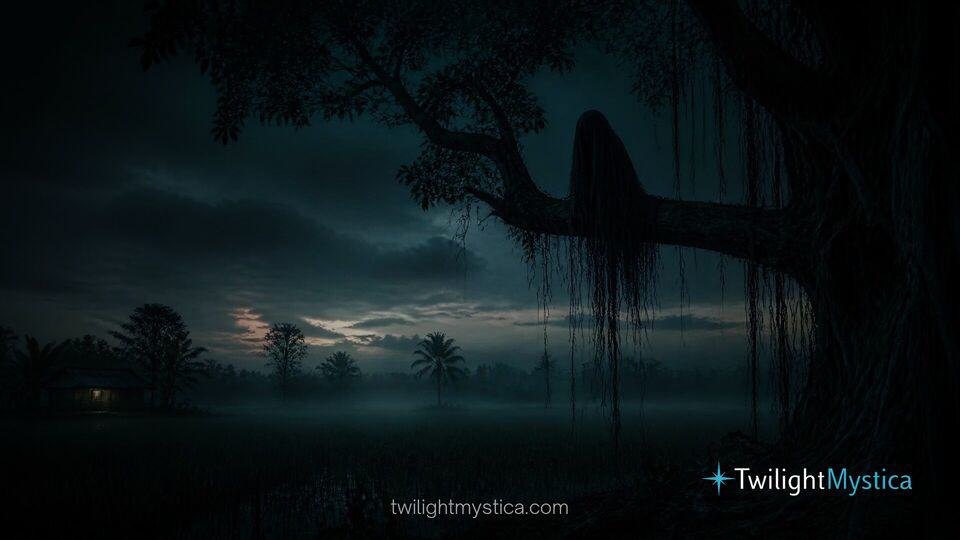
Gecho Bhoot is one of the most vivid supernatural figures in Bengali folklore: a spirit believed to dwell in trees, especially old, shadowy, or isolated ones. The phrase Gecho Bhoot tree ghost captures the core image perfectly. In village storytelling, this is not a ghost that wanders aimlessly through houses or graveyards. Instead, it belongs to the branches overhead, watching roads, ponds, fields, and lonely footpaths from its perch.
Like many traditional spirits, the Gecho Bhoot exists at the meeting point of fear, imagination, and local wisdom. It explains why certain trees feel unsettling after dark, why travelers avoid particular routes at night, and why elders warn children not to loiter beneath giant banyan or tamarind trees. In that sense, the Gecho Bhoot is more than a monster from a tale. It is also a cultural symbol tied to landscape, memory, and caution.
This article breaks down what the Gecho Bhoot is, how it behaves, why trees matter so much in the legend, and how it differs from other beings in Bengali supernatural lore. Along the way, we will also look at practical “use cases” for the legend: how communities used such stories to teach safety, shape behavior, and make sense of the unknown.
Who Is Gecho Bhoot in Bengali Folklore?
In simple terms, a Gecho Bhoot is a tree-dwelling ghost from Bengali lore. The word “gecho” suggests something associated with trees, while “bhoot” means ghost or spirit. Put together, the figure becomes a spectral being tied closely to wooded places, thick branches, and lonely natural spaces.
Unlike some named spirits with elaborate backstories, the Gecho Bhoot is often defined more by habitat and behavior than by a fixed origin story. That flexibility is part of what makes the legend so durable. One village may describe it as the restless spirit of a dead person who now lives in a tree. Another may treat it as a category of ghost that naturally inhabits certain places. In both versions, the mood is similar: if a tree feels wrong, especially at night, it may not be empty.
An easy analogy is to think of the Gecho Bhoot as the “ambush spirit” of the rural treeline. Just as a crocodile belongs to riverbanks in folklore and a household spirit belongs to domestic space, the Gecho Bhoot belongs to the canopy above a dark path. Its power comes from location. The tree is not just where it rests; the tree is part of its identity.
This also helps explain why Bengali ghost traditions include many specialized spirits. For example, stories about the Petni, an unmarried female spirit of Bengali lore focus on a very different image and emotional tone, while the Mamdo Bhoot carries its own distinct cultural associations. The Gecho Bhoot stands out because its haunting is rooted in trees and the unease of outdoor night travel.
Common Behaviors and Preferred Tree Habitats
The most famous trait of the Gecho Bhoot tree ghost is its attachment to certain trees. In folklore, not every tree is equally dangerous. Large, old, twisted, or solitary trees are more likely to attract supernatural meaning than neat orchard rows or young saplings. The tree’s visual presence matters. A broad canopy, hanging roots, deep shade, and an uncanny silhouette all make it ideal for haunting tales.
Common stories describe the Gecho Bhoot as waiting silently, dropping down suddenly, startling passersby, mimicking sounds, or luring lonely travelers into confusion. Sometimes it is merely mischievous; sometimes it is actively dangerous. In milder tales, it causes a person to lose direction, stumble in fear, or run home in panic. In darker ones, it attacks the unwary, drains vitality, or leads someone toward injury.
From a storytelling perspective, this behavior makes sense. A tree ghost is most effective when it uses height, concealment, and surprise. It is like the folklore version of a hidden prankster mixed with a predator in the branches. The listener imagines leaves rustling overhead, unseen eyes in the dark, and the terror of feeling watched from above.
Tamarind and Banyan Tree Hauntings
Two trees appear again and again in South Asian ghost lore: the tamarind and the banyan. In Bengali settings, both are natural homes for eerie stories. Tamarind trees often carry an ominous reputation because of their dense shade and strange atmosphere, especially in low light. Banyan trees, with their massive trunks and hanging aerial roots, look ancient and otherworldly even in daylight.
If you want a modern analogy, imagine how a horror film uses a creaking abandoned house. Folklore uses the banyan tree in a similar way. It is visually dramatic, easy to remember, and naturally charged with mood. A giant tree near a pond or crossroads practically invites a ghost story.
These tree hauntings also reflect how rural people read the environment. A huge tree may shelter animals, hide snakes, block moonlight, or create misleading shadows. By saying a Gecho Bhoot lives there, the story turns environmental caution into memorable narrative. “Do not linger under that tree at night” becomes stronger when paired with a ghost.
Pranks and Attacks on Unwary Villagers
Many accounts portray the Gecho Bhoot as a trickster. It may shake branches for no visible reason, throw twigs, imitate familiar voices, or create the sensation that someone is following a traveler. These pranks fit a larger pattern in ghost folklore, where spirits exploit darkness and uncertainty rather than relying only on direct confrontation.
At other times, the Gecho Bhoot is more menacing. It may leap onto a person’s shoulders, cause fainting, or target those who are alone, intoxicated, exhausted, or traveling too late. The underlying message is easy to spot: vulnerability invites danger. In practical terms, such stories may have discouraged risky nighttime movement through isolated areas.
This is one of the most useful ways to understand the legend. The Gecho Bhoot acts almost like a folk warning system. Its “use case” in community life is clear: keep children close after dark, encourage group travel, and teach respect for unfamiliar terrain. Just as modern parents might warn children about unsafe alleys or abandoned buildings, earlier communities used the language of spirits.
Gecho Bhoot tree ghost as a Cultural Warning Symbol
The Gecho Bhoot tree ghost is not just a scary image; it also functions as a social tool. Folklore often preserves rules in memorable form, and tree ghosts are excellent carriers of those rules. They tell people where not to go, when not to wander, and which spaces require respect.
Consider a few real-world-style examples of how the legend works:
- Child safety: Children are warned not to climb large trees at dusk or play near deserted ponds after sunset.
- Travel caution: Lone travelers are encouraged to avoid isolated shortcuts through groves at night.
- Environmental respect: Ancient trees become places of awe rather than careless destruction.
- Community memory: If a past accident happened near a tree, the site may gain a ghost story that keeps later generations alert.
This pattern is not unique to Bengal. Many cultures place spirits in forests, wells, mountains, or crossroads. The logic is similar everywhere: attach danger to a vivid supernatural figure, and people remember the warning better. In that sense, the Gecho Bhoot is like a cultural signboard written in the language of myth.
It also shares thematic ground with other regional legends tied to place and fear. For instance, the Nishi Dak night spirit warns listeners about answering mysterious calls in the dark, while the Aleya ghost lights express dangers associated with wetlands and disorientation. Each legend maps fear onto a landscape.
Differences Between Gecho Bhoot and Other Tree Spirits
It is tempting to treat every tree-dwelling spirit as interchangeable, but the Gecho Bhoot has a distinct place in Bengali lore. Its identity is strongly local, shaped by Bengali language, rural environment, and regional storytelling habits. While many cultures speak of spirits in trees, not all of them behave like Gecho Bhoot.
One key difference is tone. Some tree spirits in world mythology are guardians, nature beings, or morally ambiguous presences. The Gecho Bhoot, by contrast, usually appears in a ghostly and unsettling frame. It is less a noble forest entity and more a haunting presence tied to fear, surprise, and the vulnerability of travelers.
Another difference is its place within a larger Bengali ghost taxonomy. Bengali folklore is rich with specialized figures, each associated with a type of death, social role, appetite, or haunting style. Compare the Gecho Bhoot with the fish-obsessed Mechho Bhoot, or with the more elevated and often less malicious Brahmadaitya. The Gecho Bhoot is defined chiefly by arboreal space and ambush-like behavior.
Habitat-Based Identity
Many Bengali spirits are identified by what they do or who they once were. Gecho Bhoot is especially tied to where it stays. That makes it easier to visualize and easier to localize. A storyteller can point to a specific tree and instantly anchor the legend in a real place.
Fear of the Overhead Unknown
There is also a psychological difference. Humans are used to watching the ground in dangerous terrain. A tree ghost reverses that instinct by moving danger above eye level. That small shift makes the idea unusually effective. It is the same reason a rustle in the branches can feel more disturbing than a sound on the road.
Why the Gecho Bhoot Still Fascinates Readers Today
The Gecho Bhoot survives because it combines strong imagery with flexible meaning. Even readers who do not believe in ghosts recognize the emotional power of the legend. Most people have experienced a moment when a tree looked strange in twilight, when shadows played tricks, or when a familiar path felt completely different after dark. The Gecho Bhoot gives that feeling a face.
It also appeals to modern audiences interested in folklore as cultural storytelling rather than literal belief. Through one tree ghost, you can explore rural ecology, childhood fears, oral tradition, social discipline, and regional identity. That makes the legend useful for writers, educators, horror fans, and anyone curious about South Asian supernatural traditions.
In a way, the Gecho Bhoot is a perfect example of how folklore works. It turns setting into story, anxiety into character, and practical caution into memorable myth. The result is a spirit that feels simple at first glance but reveals deeper cultural meaning the more closely you study it.
Recap: Understanding the Gecho Bhoot Legend
The Gecho Bhoot tree ghost is a tree-dwelling spirit from Bengali folklore, most often associated with old, shadowy trees and the fear of nighttime travel. It is known for lurking in branches, playing pranks, frightening villagers, and sometimes attacking people who move through isolated places alone. Trees like banyan and tamarind become central to the legend because their appearance, age, and atmosphere make them natural homes for haunting stories.
More importantly, the Gecho Bhoot is not just a spooky character. It works as a cultural warning, a storytelling device, and a symbol of how communities interpret dangerous or uncanny landscapes. Whether read as ghost lore, social memory, or psychological metaphor, the legend remains one of the most compelling examples of Bengali supernatural imagination.
For anyone exploring Bengali spirits, the Gecho Bhoot offers a memorable starting point: a ghost above your head, a haunted tree at the edge of the road, and a folklore tradition that transforms ordinary nature into living mystery.