Harong Hurong cave mystery is one of those regional legends that feels larger than the place itself. In Sylhet, where hills, forests, and tea gardens already create a dreamlike atmosphere, stories about a haunted cave take on a special power. Harong Hurong Cave is often described not just as a physical cavern, but as a threshold: a place where geography, fear, religion, rumor, and folklore all overlap.
For some, it is a hidden natural site wrapped in superstition. For others, it is a warning zone linked to spirits, vanishings, and buried treasure. And for modern readers drawn to eerie destinations, it represents something else entirely: the kind of mystery that survives because nobody can fully separate fact from legend.
This is what makes the story so compelling. Like a half-seen shape in the dark, Harong Hurong Cave invites interpretation. One person sees a haunted chamber, another sees a misunderstood landscape, and another sees a cultural memory preserved through storytelling. In that sense, the cave functions a bit like a locked room in a ghost story: the less we know for certain, the more powerful the legend becomes.
The History and Location of Harong Hurong Cave
Harong Hurong Cave is associated with the Sylhet region of Bangladesh, an area known for lush greenery, hill tracts, shrines, streams, tea estates, and old oral traditions. Even without the supernatural layer, Sylhet is the kind of landscape where mystery easily takes root. Dense vegetation, shifting weather, and remote terrain naturally encourage stories about hidden places and unseen dangers.
Proximity to Malnichhera Tea Estate
One reason the cave remains so intriguing is its connection in local discussion to the wider Sylhet environment, especially well-known landmarks such as Malnichhera Tea Estate. That proximity matters because tea estates often carry their own atmosphere of age, isolation, and inherited memory. A haunted cave near such a setting feels almost inevitable in folklore terms.
Think of it like a stage set. A bright shopping district rarely produces enduring ghost legends, but a misty, semi-remote landscape with old pathways and natural hollows does. The cave becomes the focal point, while the surrounding terrain supplies the mood. This is similar to how marshes, banyan groves, and abandoned ponds become story magnets in Bengali folklore.
As a use case for cultural storytelling, Harong Hurong shows how place shapes belief. A cave in a modern concrete neighborhood might be treated as a curiosity. A cave in a storied Sylheti landscape becomes a vessel for warnings, myths, and inherited awe.
Understanding the Harong Hurong cave mystery
At its core, the Harong Hurong cave mystery is not about proving a single event happened. It is about understanding why a location acquires an unsettling reputation and why that reputation persists. The mystery usually rests on a cluster of ideas: strange sounds, unexplained fear, dangerous exploration, local taboos, and tales of people who went too far.
This is common in cave folklore around the world. Caves are natural symbols of the unknown. They are dark, enclosed, hard to map, and often acoustically deceptive. A gust of wind can sound like a whisper. Water can echo like footsteps. Shadows shift unpredictably. In folklore, such sensory uncertainty becomes evidence of a presence.
An easy analogy is this: if open fields represent what a community can see and control, caves represent what lies outside ordinary control. That makes them ideal settings for stories about hidden beings, sacred boundaries, or punishment for human greed.
For readers interested in comparative folklore, Harong Hurong belongs to the same wider tradition as haunted wetlands, spirit-haunted trees, and treasure-guarding sites. Bangladesh has many such mysteries, including strange atmospheric phenomena like the Barisal Guns mystery, where unexplained sounds inspire lasting speculation.
Haunted Folklore and Local Myths
The haunting reputation of Harong Hurong Cave grows from oral storytelling rather than a single documented source. That is important. Oral legends evolve with every retelling. Details shift, tensions sharpen, and the cave slowly becomes more than a cave. It becomes a cautionary symbol.
Legends of Guarded Treasures and Lost Explorers
One of the most persistent motifs attached to mysterious caves is the idea of hidden treasure. In South Asian folklore, treasure is rarely free for the taking. It is guarded, cursed, concealed, or watched by supernatural beings. Harong Hurong is often discussed in exactly that register: as a place where wealth or secrets may lie within, but at a terrible price.
This connects naturally to the old Bengali belief in spirit guardians of hidden riches. Readers familiar with the legend of Jokkho, the treasure-guarding spirit will recognize the pattern. The message is moral as much as supernatural: greed leads people into danger, and not every hidden thing is meant to be uncovered.
Alongside treasure stories come tales of explorers or curious visitors who became disoriented, vanished, or returned deeply shaken. Whether literal or exaggerated, these narratives function as examples. They warn listeners that courage without respect becomes recklessness. In practical terms, that also makes sense. Caves can be physically hazardous, so folklore may preserve safety advice in dramatic form.
A useful real-world analogy would be modern urban legends about forbidden tunnels or abandoned buildings. Teenagers dare each other to enter, stories spread about what someone saw inside, and soon the location develops a life of its own. Harong Hurong works similarly, except with deeper folkloric roots and stronger spiritual overtones.
Spiritual Taboos Surrounding the Cavern Entrance
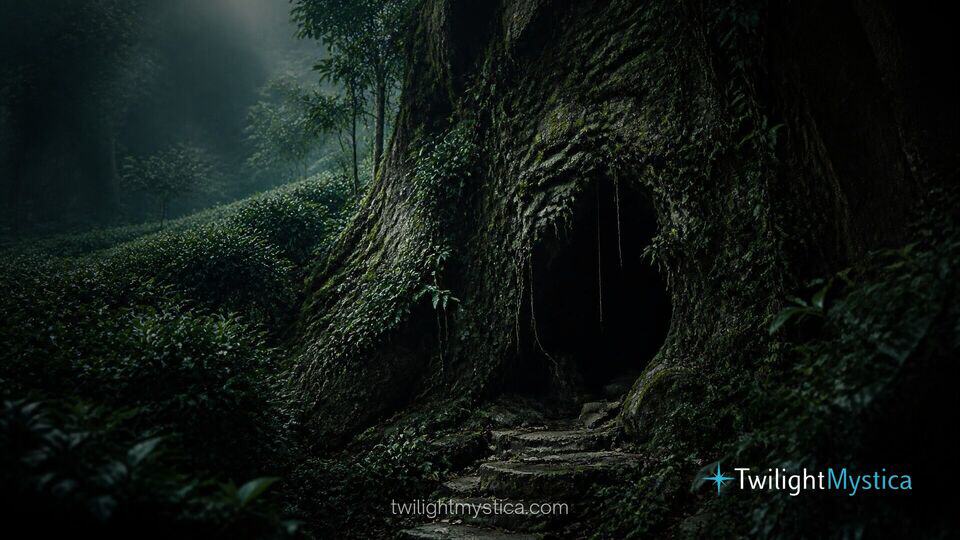
Another major element in the legend is taboo. Certain places in traditional belief are not merely dangerous; they are spiritually off-limits. The entrance to a haunted cave can be imagined as a boundary zone, where ordinary rules of movement and speech no longer apply. People may avoid entering at dusk, refrain from speaking loudly nearby, or discourage solitary visits.
Such taboos are not random. They help communities mark risky places and assign them meaning. A parent warning a child away from a cave by saying “spirits live there” may be doing more than spreading fear; they may be translating environmental danger into a memorable moral lesson.
This theme appears across Bengali lore. Night calling spirits, disorienting ghosts, and threshold-based hauntings all reinforce the same idea: some spaces become unsafe when human beings ignore local wisdom. Stories like the Kanabhulo night ghost legend and the Nishi Dak spirit call similarly revolve around confusion, misdirection, and the danger of crossing unseen boundaries.
Why Caves Inspire Fear So Easily
To understand the staying power of Harong Hurong’s legend, it helps to look beyond the supernatural and examine human psychology. Caves compress many primal fears into one setting: darkness, confinement, silence, echo, and the possibility of getting lost. Even a skeptic can feel uneasy in such a place.
Imagine walking into a cavern where your phone signal drops, the temperature changes, and every sound returns distorted. That experience can make the imagination race. In low-visibility spaces, the mind often fills gaps with narrative. What cannot be identified quickly is often interpreted as a threat. Folklore then gives that threat a name.
This is one reason haunted cave stories appear in so many cultures. They are memorable because they attach supernatural meaning to a setting that already feels uncanny. Harong Hurong Cave may therefore be read in two ways at once: as a possible haunted site in local belief and as an excellent example of how fear naturally gathers around unknown spaces.
The Modern Appeal of Sylhet's Dark Tourism
In recent years, mysterious and allegedly haunted places have gained renewed attention from travelers, bloggers, video creators, and folklore enthusiasts. Sylhet’s scenic beauty already attracts visitors, but legends like Harong Hurong add another layer: dark tourism. This does not always mean people literally believe every ghost story. Often, they are drawn by atmosphere, cultural curiosity, and the thrill of standing where myth is said to live.
As a use case, Harong Hurong Cave could appeal to several audiences at once: paranormal enthusiasts, students of folklore, heritage writers, and travelers interested in lesser-known stories of Bangladesh. For a content creator, it offers mood and mystery. For a historian of belief, it offers a case study in how local legends survive. For a cautious traveler, it is a reminder that storytelling can shape the identity of a landscape as much as maps do.
That said, dark tourism works best when approached respectfully. Places connected to local fear, faith, or taboo should not be treated as mere spectacle. Visitors and readers should recognize that folklore is part of cultural heritage. The goal is not to mock belief, but to understand what the legend reveals about memory, risk, and community identity.
This respectful approach also helps connect Harong Hurong to the wider world of Bengali supernatural tradition, including stories of tree spirits such as the Gecho Bhoot and emotionally charged local hauntings like the Shahidullah Hall pond ghost legend.
What the Legend Really Tells Us
Whether Harong Hurong Cave is haunted in a literal sense is ultimately the least important question for many readers. The more revealing question is why the story endures. Legends survive when they meet a social need. They entertain, warn, organize memory, and turn geography into meaning.
In this case, the cave becomes a symbol of three things at once. First, it represents the unknown, which humans instinctively dramatize. Second, it reflects local values about caution, respect, and the dangers of greed. Third, it demonstrates how a region like Sylhet preserves its identity through story as much as through landmarks.
You could compare Harong Hurong to a cultural mirror. Look into it as a skeptic, and you see environmental fear and oral tradition. Look into it as a believer, and you see a spiritually charged place where unseen forces guard their boundary. Either way, the mirror still reflects something true about how people experience mystery.
Summary
The Harong Hurong cave mystery remains compelling because it sits at the intersection of natural landscape and supernatural imagination. Rooted in Sylhet’s evocative setting, linked in local memory to places such as Malnichhera Tea Estate, and enriched by tales of treasure, lost explorers, and taboo, the cave has become far more than a hole in stone.
Its legend works on multiple levels: as haunted folklore, as a practical warning, as a psychological response to darkness and isolation, and as an example of modern dark-tourism fascination. Whether one approaches Harong Hurong as a believer, a skeptic, or simply a curious reader, the result is the same: the cave endures because mystery itself is part of its power.
And that may be the final lesson of Harong Hurong. Some places are remembered not because they are fully explained, but because they resist explanation just enough to keep the story alive.