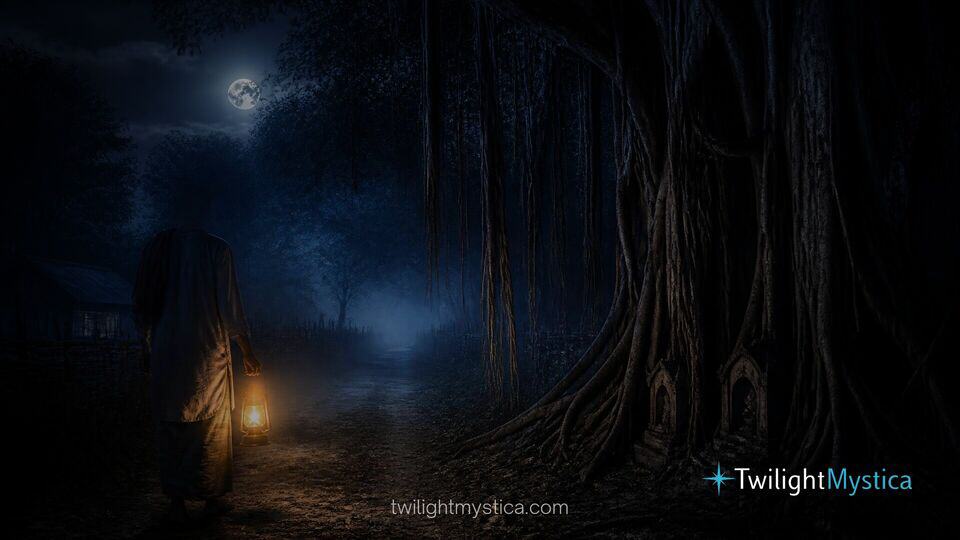
In Bengali folklore, not every ghost attacks with claws, screams, or visible terror. Some haunt in quieter ways. The Kanabhulo ghost legend belongs to that unsettling category: a night spirit believed to confuse, mislead, and disorient lonely travelers until familiar roads become strange and safe paths turn dangerous. Rather than appearing as a clearly seen monster, Kanabhulo is feared for its power over perception. A person may think they are walking home, following a known field path, or crossing a routine village road, only to realize too late that they have wandered somewhere completely different.
This makes Kanabhulo one of the most psychologically interesting figures in Bengal's supernatural tradition. It represents the fear of getting lost, the uncertainty of darkness, and the fragile trust people place in memory and direction. In regions where travel once depended on moonlight, narrow embankments, dirt paths, wetlands, and tree-lined tracks, a spirit that could distort orientation felt entirely plausible. Like the ominous call in the legend of Nishi Dak, Kanabhulo reflects a danger rooted in the night itself.
This article explores what Kanabhulo is, how the legend works, why it remained powerful in rural storytelling, and what deeper cultural meanings hide inside this ghostly tale.
The Origins of Kanabhulo in Bengali Folklore
The name Kanabhulo is commonly understood through the idea of becoming confused, misdirected, or mentally led astray. In folklore, Kanabhulo is not always described with a fixed body or appearance. That fluidity is important. Some Bengali spirits are known for a distinct form, such as long hair, backward feet, or a headless frame. Kanabhulo, by contrast, is defined more by effect than by shape. You know it by what happens around you: the road bends incorrectly, the pond appears where no pond should be, the bamboo grove seems closer than it is, and the walk home stretches far longer than it should.
This kind of spirit likely grew from lived environmental experience. Rural Bengal has long included foggy fields, riverbanks, marshes, paddy paths, orchards, and dim roads where landmarks can shift in darkness. A traveler who lost direction at night could easily feel as though something had tampered with the world itself. Folklore gave that experience a name and a personality.
Kanabhulo also fits within a wider Bengali ghost universe populated by spirits tied to place, habit, and human vulnerability. For example, the Aleya ghost lights are linked to deceptive lights over wetlands, while Besho Bhoot is associated with eerie bamboo groves. Kanabhulo stands out because its haunting happens inside the victim's sense of direction, making the mind itself part of the haunted landscape.
How the Disorienting Spirit Traps Unsuspecting Travelers
The central pattern of the legend is simple but deeply effective. A person travels alone at night. At first, nothing seems wrong. They recognize the road, a tree, a bend, or a canal. Then small irregularities begin to appear. The path feels longer. A known house is missing. A turn leads back to the same place. Sounds seem muffled or strangely distant. The traveler becomes anxious, and that anxiety makes judgment worse. In folklore, this is the moment Kanabhulo has begun its work.
A useful analogy is walking through a maze that rearranges itself every few minutes. Another is a malfunctioning map app that insists you are on the correct road while everything around you says otherwise. Kanabhulo is the supernatural version of cognitive misalignment: your internal map and the external world stop matching.
Stories sometimes suggest that the spirit lures people toward ponds, ditches, remote fields, cremation grounds, or dense groves. In practical terms, such places were genuinely dangerous at night. The legend therefore works both as a ghost story and as a survival warning. Do not travel alone too late. Do not trust overconfidence in darkness. Do not assume every familiar route remains safe after sundown.
Psychological Triggers and Hypnotic Illusion
One reason the Kanabhulo ghost legend endures is that it maps neatly onto real human experience. Fatigue, darkness, fear, isolation, and silence can distort perception. When a person is tired or frightened, the brain fills gaps with guesses. Distances seem warped. Repeated scenery feels uncanny. Small mistakes can spiral into panic. Folklore interprets that collapse of orientation as the touch of Kanabhulo.
Think of it like stage hypnosis mixed with environmental confusion. The victim is not simply lost in a physical sense; they are trapped in a loop of doubt. Once they begin second-guessing each step, even obvious landmarks lose authority. A pond becomes a road edge. A shadow looks like an opening. A familiar palm tree seems like a stranger's yard marker.
This is why Kanabhulo is more unnerving than many aggressive spirits. A violent ghost threatens the body. Kanabhulo threatens the reliability of the senses. That makes it a particularly modern-feeling legend, because it resembles the timeless fear of not being able to trust one's own mind.
Tales from Rural Bangladesh
Across Bengali-speaking regions, stories of night confusion often appear in oral tradition with local variation. In some tellings, a farmer returning from a market keeps circling the same banyan tree. In others, a fisherman walking home from a riverbank hears dogs barking from the wrong direction and follows the sound into open marshland. Elsewhere, a student taking a shortcut through fields reaches a destination that should be impossible, as though the landscape folded around him.
These stories are usually told with ordinary protagonists rather than heroic ones. That matters. Kanabhulo is frightening because it targets everyday people doing ordinary things: heading home, visiting relatives, crossing a village boundary, returning after prayer or market work. In that sense, the legend resembles cautionary folklore more than epic myth.
It also shares thematic ground with other Bengali supernatural narratives in which the night disturbs normal judgment. Readers interested in related motifs may also explore the Mamdo Bhoot legend or the uncanny vulnerability described in Boba Jinn sleep paralysis folklore. Each expresses a different fear, but all turn ordinary human weakness into supernatural danger.
Kanabhulo Ghost Legend as a Cultural Warning System
Like many folktales, Kanabhulo likely served practical social uses beyond entertainment. It warned children not to roam after dark. It discouraged solitary travel through unsafe terrain. It reinforced the value of companionship, local knowledge, and caution. Before electric lighting and paved roads became common, these lessons could be lifesaving.
In that way, Kanabhulo functions much like a folk safety manual disguised as a ghost. Instead of saying, "Night travel is risky because landmarks disappear and terrain becomes deceptive," the culture says, "Beware the spirit that makes you lose your way." The second version is more memorable, more vivid, and easier to pass down across generations.
Use cases for such a legend are easy to imagine. Parents might invoke Kanabhulo to keep children from wandering near ponds at night. Elders might retell a story after someone took an unnecessary shortcut through fields. Village communities might use the image of the ghost to explain why even confident adults should respect darkness, monsoon mist, and unfamiliar routes.
Cultural Rituals and Defenses Against Kanabhulo
Folkloric defenses against disorienting spirits often combine religion, habit, and practical technique. A traveler might recite sacred words, avoid responding to strange sounds, carry a light, walk with companions, or pause rather than rushing deeper into uncertainty. The supernatural solution and the practical solution often overlap.
That overlap is one of the most revealing parts of the legend. Even if someone truly believed Kanabhulo was haunting a road, the advised response usually encouraged calmer, safer behavior. Stop moving recklessly. Reorient yourself. Pray. Call for a known person. Wait for daylight if necessary. In modern terms, these are sensible responses to disorientation in dangerous terrain.
Why Ritual Works in Folklore
Rituals provide a sense of control when the world feels unstable. If Kanabhulo represents confusion, then any repeated action that restores mental focus becomes symbolically powerful. A prayer, a mantra, a remembered instruction from an elder, or even the act of turning back can break the spell in storytelling terms.
An analogy here is rebooting a frozen system. The night ghost "scrambles" the victim's perception; ritual restores order. Whether one interprets that spiritually or psychologically, the story logic remains strong.
Common Protective Themes
- Do not panic when the path seems wrong.
- Do not chase distant voices or lights without certainty.
- Travel in groups when crossing isolated areas at night.
- Use prayer or recitation to regain courage and concentration.
- Respect dangerous landscapes such as marshes, ponds, and groves after dark.
Why Kanabhulo Still Feels Relevant Today
Even in an age of GPS, streetlights, and mobile phones, the core fear behind Kanabhulo has not vanished. People still experience disorientation, panic, and the sense that a once-familiar place has become strange. Anyone who has taken a wrong turn at night, become lost in fog, or felt irrational dread on an empty road can recognize the emotional truth inside the legend.
That is why the story continues to resonate. Kanabhulo is not only a ghost of rural Bengal. It is also a symbol of what happens when certainty breaks down. The legend dramatizes a universal human experience: the moment when you realize that knowing the way and finding the way are not always the same thing.
It also enriches the broader tapestry of Bengali supernatural belief, where each spirit embodies a specific anxiety. Some ghosts guard places, some imitate loved ones, some attack sleepers, and some, like Kanabhulo, turn orientation itself into a haunting.
Final Thoughts on the Kanabhulo Ghost Legend
The Kanabhulo ghost legend is memorable not because of a grotesque appearance, but because of its subtle terror. It imagines a force that does not need to touch you directly. It only needs to shift your sense of place by a few degrees until the ordinary becomes dangerous. Through that idea, the legend captures the risks of night travel, the instability of human perception, and the power of folklore to encode practical wisdom inside unforgettable stories.
In summary, Kanabhulo is best understood as both a supernatural night ghost and a cultural metaphor. It warns, explains, and unsettles all at once. Whether read as spiritual belief, rural cautionary tale, or psychological folklore, it remains one of Bengal's most fascinating legends of the dark.