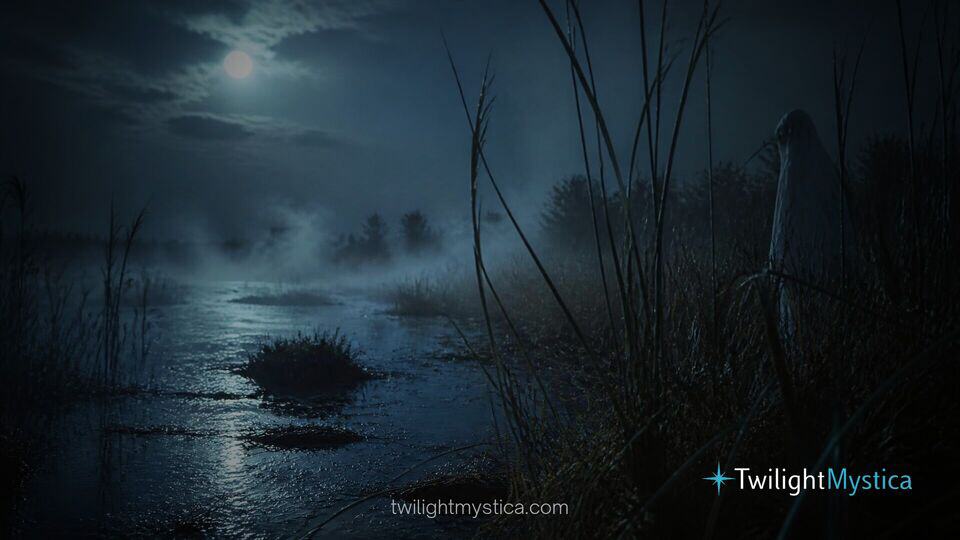
The Kander Bhoot legend belongs to the rich world of Bengali folklore, where rivers, ponds, forests, and marshes are rarely treated as empty landscapes. In these traditions, the land itself feels alive, and dangerous places often gain supernatural guardians, tricksters, or mournful spirits. Kander Bhoot is remembered as one of the most unsettling among them: a crying marshland ghost associated with wet, lonely terrain and the fear of being led astray in the dark.
At its core, Kander Bhoot is a spirit of warning. The tale usually centers on swampy fields, muddy paths, reed-filled wetlands, or waterlogged village edges where visibility is poor and sound travels strangely. People describe hearing sobbing, wailing, or distressed cries at night. Anyone who follows the sound too confidently may become confused, sink into dangerous ground, or vanish deeper into the marsh. In that way, the legend functions both as a ghost story and as practical environmental wisdom.
Like many folk beings, Kander Bhoot is not important only because villagers believed in it literally. It matters because it translates real rural danger into a memorable narrative. A swamp can pull down feet, distort direction, and carry sound in misleading ways. Folklore gives those risks a face and a voice. That is why the Kander Bhoot legend remains compelling even to modern readers who approach it as myth, metaphor, or cultural memory.
The Myth of Kander Bhoot in Rural Folklore
Origins and Characteristics of the Crying Spirit
In oral tradition, Kander Bhoot is generally imagined as a sorrowful ghost tied to marshes, lowlands, and isolated wet places. The word “kander” is associated with crying or lamentation, which explains why the spirit is so often described through sound before appearance. Unlike a dramatic monster that attacks openly, Kander Bhoot is eerie because it is heard first. That crying turns the landscape into something emotionally charged, as if the wetland itself is grieving.
Descriptions vary from village to village. In some retellings, the spirit is a lost soul wandering between water and land. In others, it is a deceptive entity that imitates human distress to lure compassionate passersby. Sometimes it appears as a shadowy figure, a woman in white, or a barely seen presence near reeds and mist. This flexibility is common in folklore. The details shift, but the emotional pattern stays the same: isolation, pity, curiosity, and danger.
An easy analogy is to think of Kander Bhoot as a supernatural version of a false distress signal. Just as a flashing warning light can make someone stop and investigate, the crying of the spirit pulls attention and overrides caution. That is what makes the legend powerful. It does not rely on brute force. It uses human instinct against itself.
How the Ghost Lures Travelers Into Dangerous Swamps
The most memorable feature of the Kander Bhoot legend is its method of luring. A traveler crossing a marsh path at dusk or late night hears crying nearby. The sound seems close, then far, then close again. Believing someone is injured, abandoned, or mourning, the traveler leaves the safe route and moves toward the voice. Instead of finding a person, they encounter deeper mud, hidden water, disorienting fog, or a maze of reeds.
This idea reflects a very real feature of wetland environments: they distort movement and sound. In darkness, one patch of land can look much like another. Waterlogged ground may appear firm until stepped on. Echoes bounce oddly over open water and mud. Folklore dramatizes those natural hazards by imagining an intelligence behind them.
For example, elders might warn children not to cross low marshland after sundown because “the crying spirit will call you.” On the surface, that sounds supernatural. In practice, it works like a safety rule. It keeps inexperienced people away from slippery banks, hidden pools, and areas where help is far away. Similar cautionary storytelling appears in other Bengali tales, including the misleading calls of Nishi Dak and the wandering confusion associated with Kanabhulo.
Why Marshland Spirits Appear in Folk Belief
Marshes are perfect settings for supernatural stories because they sit between categories. They are not quite land and not quite open water. They shift with season, flood, rain, and tide. Crops may grow nearby, yet danger hides under the surface. In traditional communities, places like these often become liminal zones, meaning in-between spaces where the ordinary world feels less stable.
Kander Bhoot fits this pattern exactly. A marsh at night can produce unease even without a ghost. The air is heavy, the path uncertain, and the sounds unfamiliar. Frogs, wind, birds, and distant voices blend into something uncanny. When people repeatedly experience fear in such a setting, folklore organizes that fear into a story. The spirit becomes a way to explain why some places feel wrong after dark.
A useful modern comparison would be a road that locals call cursed because accidents happen there often. Even if there are practical reasons like poor lighting or sharp turns, people still build stories around it. The legend helps the community remember the risk. Kander Bhoot serves a similar purpose for wetland geography.
Environmental Memory in Folktales
Many traditional ghost stories preserve local knowledge. They encode where not to walk, when not to travel, and what signs to take seriously. In that sense, Kander Bhoot is not just horror entertainment. It is also a cultural map. The ghost marks unsafe zones the way a signpost might in a modern setting.
This also explains why Bengali folklore includes several spirits tied to specific landscapes. Trees may belong to one kind of ghost, rivers to another, bamboo groves to another still. Readers interested in these place-based spirits may notice parallels with the tree-dwelling Gecho Bhoot, the bamboo-haunting Besho Bhoot, and the wetland mystery of Aleya ghost lights. Each figure gives form to a different natural setting and the anxieties attached to it.
Cultural Significance and Village Precautions
The enduring strength of the Kander Bhoot legend lies in how it joins emotion, geography, and community behavior. It turns the simple act of hearing a cry at night into a moral and practical test: should you rush forward, or should you pause and think? In folklore, the wrong answer can be fatal.
Stories like this also reinforce collective habits. Villagers may travel in groups after dusk, avoid shortcuts through marshes, carry lamps, or call out from a safe distance before approaching a suspicious sound. Even if a listener doubts the ghost, the caution remains useful. Folklore often works best this way. Belief does not need to be absolute for the lesson to endure.
Traditional Safeguards Against Marshland Entities
Traditional precautions in stories about Kander Bhoot usually combine spiritual protection with plain common sense. A traveler might recite a prayer, invoke God’s name, avoid responding immediately to mysterious cries, or refuse to leave the main path. Elders may advise turning back rather than investigating an unexplained voice near water or reeds.
These actions are significant because they show how folklore teaches procedure. Think of them as a traditional safety checklist:
- Do not travel alone through marshland at night.
- Stay on known paths instead of following sounds off-route.
- Carry light so shadows and uneven ground are easier to judge.
- Pause before reacting to cries or calls from uncertain directions.
- Rely on group judgment rather than panic or curiosity.
In modern terms, these are sensible risk-management habits wrapped in supernatural language. The legend gives them urgency and emotional force.
Kander Bhoot in Modern Bangladeshi Pop Culture
Today, Kander Bhoot survives less as a rigid belief and more as part of a wider cultural imagination. It appears in conversations about rural ghost lore, in retellings online, in storytelling videos, and in discussions of Bengal’s supernatural heritage. Modern audiences may interpret the figure psychologically, symbolically, or aesthetically rather than literally.
That shift does not weaken the legend. If anything, it broadens its appeal. Horror fans see a haunting image: a weeping presence in a moonlit marsh. Folklore readers see a survival tale disguised as a ghost story. Cultural historians see a record of how communities understood dangerous environments. Writers and filmmakers see rich atmosphere, especially when pairing Kander Bhoot with other Bengali spirit traditions such as water entities, night callers, or village apparitions.
Reading the Kander Bhoot Legend Today
As a Ghost Story
Read literally, Kander Bhoot is a classic cautionary specter: sorrowful, elusive, and deadly. It belongs to the family of spirits that do not merely haunt a place but weaponize confusion. The crying is the hook, and the marsh is the trap.
As a Social Warning
Read symbolically, the tale warns against impulsive reactions in dangerous settings. Compassion is good, but acting without awareness can lead to harm. The legend teaches restraint, especially in places where the environment can deceive the senses.
As Cultural Heritage
Read historically, Kander Bhoot represents how Bengali communities gave narrative shape to fear, grief, and ecological uncertainty. It shows that folklore is not random fantasy. It is a way of preserving memory, transmitting caution, and turning local landscape into shared meaning.
Conclusion: Why the Kander Bhoot Legend Endures
The Kander Bhoot legend endures because it does several things at once. It delivers an eerie ghost story, explains the unease of marshland travel, and passes down practical village wisdom. The spirit’s crying voice symbolizes more than supernatural sorrow. It represents the call of dangerous curiosity, the uncertainty of wetlands, and the thin line between sympathy and recklessness.
In summary, Kander Bhoot is best understood as Bengal’s crying marshland spirit and as a powerful example of how folklore transforms landscape into legend. Whether one sees it as a real haunting, a cautionary tale, or a poetic memory of rural hazards, the story remains vivid because it speaks to a timeless fear: hearing something in the dark, stepping off the safe path, and realizing too late that the land itself may not let you return.