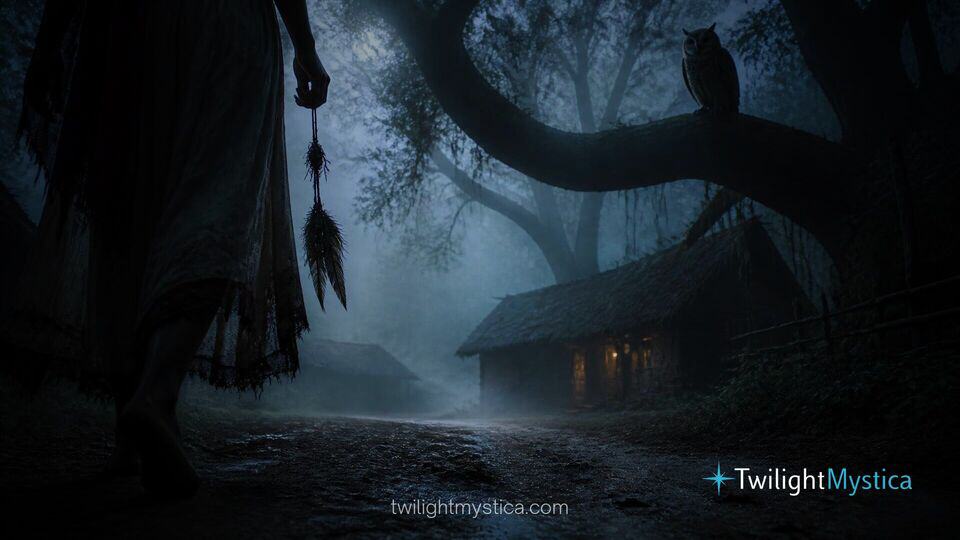
The Penchapechi owl ghost is one of the more unsettling figures in Bengali folklore: a nocturnal spirit associated with owls, darkness, and the vulnerability of people caught alone after sunset. In village storytelling, Penchapechi is not just a bird and not just a ghost. It is a supernatural being that blends the familiar cry of an owl with the deeper fear that the night is watching. Like many folk spirits, it lives in the space between warning tale and living belief, helping communities explain danger in forests, on village paths, and in lonely stretches of wilderness.
What makes Penchapechi especially frightening is its dual nature. It appears in the shape of an owl or transforms through owl-like features, yet it is described as having intent, cunning, and hunger. In that sense, it works like an analogy for hidden threats: something that looks like part of the natural world but is actually something predatory beneath the surface. Just as a calm pond may hide deep mud, an ordinary night bird in folklore may conceal a spirit with deadly purpose.
This explainer breaks down what Penchapechi is, how it behaves, why it appears in Bengali storytelling, and what the legend reveals about fear, place, and memory in Bengal's supernatural imagination.
Who Is Penchapechi in Bengali Folklore?
Penchapechi is generally understood as a ghostly or demonic female-coded spirit linked to the owl, a creature long associated in South Asian folk imagination with omens, night vision, and uncanny knowledge. The name itself evokes the owl connection, which is central to the legend. Rather than acting like a household ghost tied to a single death, Penchapechi belongs more to the landscape. It is a being of edges: forest margins, silent trees, abandoned tracks, and places where human control gives way to darkness.
In folklore terms, Penchapechi functions much like a caution sign written as a story. Instead of saying, “Do not wander through the forest alone at night,” the culture gives that warning a face, a cry, and a hunting pattern. This is common in oral traditions worldwide. A supernatural figure becomes a teaching tool. In Bengal, where wetlands, groves, and rural footpaths shaped daily life for centuries, such figures helped map danger onto memory.
It also sits within a broader family of Bengali spirits that reflect different fears and environments. Readers interested in that wider supernatural world may also explore tree-dwelling spirits in the Gecho Bhoot tradition or the eerie summons of Nishi Dak, the night-calling spirit, both of which show how strongly place and sound shape Bengali ghost lore.
Appearance and Transformation as an Owl
The owl form is the legend's most memorable element. Penchapechi may be imagined as a large unnatural owl, a woman who takes on owl traits, or a spectral entity whose eyes, call, and movement mimic the bird. This shapeshifting quality matters because it turns an already mysterious nocturnal animal into a vehicle of supernatural uncertainty.
An owl is hard to track in darkness. It sees before it is seen. It moves quietly. It appears suddenly from a branch or vanishes into shadow. All of these traits translate perfectly into ghost lore. In storytelling, Penchapechi is often less horrifying because of gore and more horrifying because of stealth. Like hearing footsteps behind you and then realizing there is no one there, the fear comes from perception failing at the exact moment you need it most.
Predatory Nature in Dark Forests
Penchapechi is not typically framed as a passive haunting spirit. It is active, watchful, and dangerous. Forest paths, bamboo groves, and sparsely populated roads become its preferred territory because such places symbolize human isolation. A crowded courtyard is safe because community is near. A narrow path under dense trees is dangerous because help is far away.
This predatory quality gives the legend practical use. It warns children not to roam after dark, cautions travelers to move in groups, and reinforces the idea that wilderness demands respect. In modern terms, you can think of the story as a folk version of risk awareness. Today we might talk about visibility, disorientation, animal threats, or crime. Traditional storytelling translated those same concerns into the image of a spirit waiting above the road.
How Penchapechi Hunts Lone Travelers
Many versions of the legend emphasize a pattern: Penchapechi targets those who are separated, distracted, or already afraid. That detail is psychologically sharp. Folklore often understands that fear itself can make people vulnerable. A traveler who panics may lose the path, mishear sounds, or make reckless decisions. Penchapechi therefore represents both an external predator and the internal collapse of confidence in the dark.
Stalking Victims in the Wilderness
Stories commonly portray the spirit as following from a distance before striking. A person might hear an owl call repeatedly overhead, notice movement from tree to tree, or feel that something is keeping pace just beyond sight. This is a classic suspense mechanism in oral storytelling because it stretches dread over time. The victim is not attacked immediately. Instead, they are made to feel watched.
A useful analogy is a storm gathering at the horizon. At first it is only a change in the wind. Then the sky darkens. Then thunder confirms what the body already sensed. Penchapechi stories work the same way. The attack begins before any physical contact; it begins with atmosphere.
In some tellings, the victim is lured deeper into danger by confusion, strange cries, or the urge to investigate. That places Penchapechi beside other deceptive spirits in Bengali lore. For comparison, the lonely and tragic figure of the Petni ghost shows another side of feminine supernatural imagery, while the bizarre behavior of the Mechho Bhoot reveals how even humor and fear can coexist in the same folklore system.
Vampiric Traits in Bengal Myth
One reason Penchapechi feels especially menacing is that some descriptions give it vampiric qualities. Rather than merely scaring people, it may drain vitality, feed on blood, or leave victims weak, senseless, or near death. Whether taken literally or symbolically, this trait raises the stakes. The spirit does not only haunt; it consumes.
Folklorically, vampiric spirits often express anxieties about unexplained illness, sudden collapse, or bodies found after lonely travel. Before modern medicine or reliable lighting, communities frequently made sense of mysterious deaths through spirit narratives. Penchapechi thus becomes a story-form explanation for the unexplainable. If someone entered the night healthy and did not return the same, the legend supplied a pattern that made emotional sense.
As a use case in storytelling analysis, Penchapechi is valuable because it shows how one figure can merge several functions at once: monster, warning, omen, and explanation. Writers, folklorists, and horror creators can study it as an example of efficient myth design. One image, the owl in darkness, carries multiple meanings without long exposition.
Penchapechi in Traditional Storytelling
In oral tradition, Penchapechi likely survived not because every listener believed in it literally, but because the story was useful. It could frighten children into caution, dramatize the dangers of nighttime travel, and turn ordinary rural sounds into shared cultural memory. The cry of an owl stopped being just a sound; it became a possible sign. That is how folklore reshapes landscape. It layers meaning onto experience until the environment itself feels storied.
Traditional storytellers often rely on recognizable settings rather than elaborate mythology. A dark grove, a returning traveler, a strange call from above, a growing sense of dread: these are simple ingredients, but they are effective because they are familiar. The listener can imagine them immediately. In this way, Penchapechi resembles a well-told campfire tale. It does not need pages of backstory. It needs timing, mood, and the listener's own fear of being alone.
The legend also belongs to a broader Bengali ghost ecology in which different spirits occupy different terrains and social meanings. Some haunt trees, some roads, some ponds, some homes, and some liminal spaces between settlement and wilderness. To see how this pattern extends across the tradition, readers might compare Penchapechi with Besho Bhoot of the bamboo groves or the terrifying figure of Skondhokatah, Bengal's headless ghost. Each spirit turns a different fear into a memorable form.
Why the Owl Image Endures
The owl remains one of the strongest parts of the legend because it sits at the crossroads of reality and myth. Real owls are already eerie to many people: silent wings, reflective eyes, sudden calls, and activity at hours when humans feel least secure. Folklore does not need to invent those details. It only needs to interpret them. Penchapechi is what happens when the natural qualities of the owl are read through a supernatural lens.
Folklore, Fear, and Cultural Memory
At a deeper level, Penchapechi demonstrates how folklore preserves emotional truths. Even if a listener does not believe in owl spirits, they understand the message embedded in the tale: darkness changes perception, isolation increases risk, and nature can feel indifferent or hostile. The ghost gives shape to those truths. It is a narrative container for night fear.
This is why such legends endure even in modern times. Electric lights, paved roads, and smartphones may reduce some old dangers, but they do not erase the human response to being alone in the dark. The legend survives because the feeling survives.
Recap: What the Penchapechi Owl Ghost Represents
The Penchapechi owl ghost is best understood as a terrifying fusion of owl symbolism, wilderness danger, and Bengali supernatural imagination. It is a nocturnal predator in story form, often imagined as a ghostly owl-woman or owl-shaped spirit that stalks isolated travelers and sometimes displays vampiric traits. More than a monster, it serves as a cultural warning about venturing alone into dark and uncertain places.
As an explainer subject, Penchapechi offers a vivid example of how folklore works. It transforms practical fear into memorable narrative, uses a familiar animal as a supernatural disguise, and connects communities through shared cautionary imagery. Whether read as literal belief, symbolic warning, or atmospheric ghost lore, Penchapechi remains one of Bengal's most haunting night spirits.