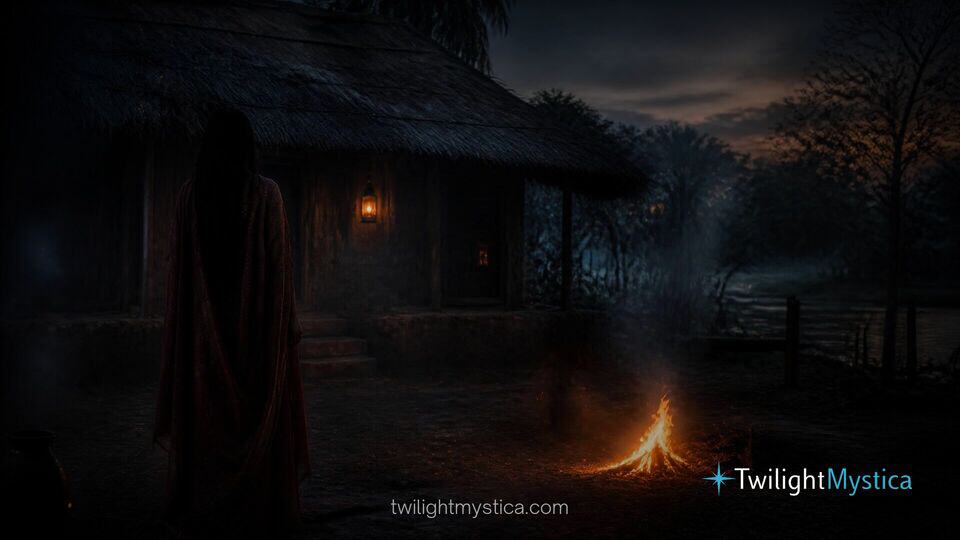
Few figures in South Asian folk belief inspire as much unease as the Daini, the witch of Bengali imagination. In village stories, whispered warnings, and moral tales passed between generations, the Daini appears as a woman tied to sorcery, curses, illness, and hidden malice. Sometimes she is imagined as an old widow living on the edge of the settlement. Sometimes she is a shadowy practitioner of ritual magic. And sometimes she is less a supernatural being than a label placed on a feared or misunderstood person.
This is what makes Daini witch folklore so compelling. It sits at the border of myth and social reality. On one side are eerie tales of dark spells, evil eyes, child-harming rituals, and midnight gatherings. On the other side are very human fears: jealousy, disease, misfortune, patriarchy, and the need to explain what cannot be easily controlled. Like many witch traditions around the world, the Daini myth tells us as much about the community that fears her as it does about the witch herself.
In Bengali lore, the Daini belongs to a wider supernatural landscape filled with spirits, omens, and dangerous beings. Readers interested in related traditions may also explore the Shakchunni spirit legend or the Petni ghost legend, both of which reveal how female supernatural figures often carry social and symbolic meaning in Bengali storytelling.
This explainer looks at what the Daini is, what powers are commonly linked to her, why village communities feared her, and how the archetype evolved over time. Think of the Daini not simply as a monster in a story, but as a cultural mirror: a figure that reflects anxieties about gender, sickness, secrecy, and the unknown.
The Role of Daini in Traditional Bengali Folklore
At the most basic level, a Daini is a witch figure in Bengali folk belief, usually imagined as a woman who has access to harmful supernatural power. Unlike a ghost, she is not always considered dead. Unlike a goddess, she is not worshipped. She occupies a dangerous middle ground: human, yet feared as someone who can manipulate invisible forces.
In oral tradition, villagers might accuse a Daini of causing unexplained fever, crop failure, infertility, livestock deaths, or sudden madness. If a child fell sick repeatedly or a household faced one misfortune after another, suspicion could gather around a woman already marked as unusual, isolated, sharp-tongued, poor, elderly, or socially vulnerable. In this sense, the Daini functioned as a ready explanation for bad luck, much like how some cultures speak of the “evil eye” to explain envy turned harmful.
An easy analogy is to think of the Daini as the Bengali village version of a social lightning rod. When fear had no clear target, the community gave it a face. That face was often female. This pattern appears in folklore across the world, but in Bengali settings it took on local colors: riverine villages, tantric undertones, household rivalries, and belief in ritual impurity or hidden intention.
The Daini as Both Character and Accusation
One important point is that the Daini is not always a fixed mythical species. She can be a story character, but she can also be an accusation. In folktales, she may fly, transform, cast curses, or feed on vitality. In real village rumor, however, “Daini” could become a social weapon. A woman seen as different might be said to have strange powers, especially if neighbors feared her knowledge of herbs, rituals, or solitary habits.
That dual role gives the myth its staying power. It works both as supernatural entertainment and as a framework for social suspicion.
Daini witch folklore and the Fear of Hidden Harm
The core fear in Daini witch folklore is not open attack but secret damage. The Daini rarely appears as a battlefield creature. Her danger lies in what cannot be seen: a muttered curse, a ritual done at night, a glance loaded with envy, a charm buried near a doorway, or food believed to be spiritually polluted.
That fear of hidden harm makes the Daini especially potent in traditional storytelling. A tiger can be fought. A thief can be caught. But a curse has no clear shape. Once people believe that misfortune has occult roots, every ordinary event begins to feel suspicious. A broken pot, a wasting illness, or a crying infant can seem like evidence.
Why the Invisible Feels More Frightening
Folklore often turns uncertainty into narrative. If there is no obvious reason for suffering, the mind reaches for a pattern. The Daini provides one. She is the explanation that ties scattered troubles into a single story. In that sense, she works much like a conspiracy figure in modern life: someone behind the scenes, blamed for outcomes that feel too chaotic to accept as random.
This is one reason witch myths endure. They do not just describe evil; they organize anxiety.
Powers, Dark Magic, and Village Superstitions
Stories about the Daini vary by region and family tradition, but several powers appear again and again. She may be said to cast curses, drain life force, spoil fertility, send illness, control spirits, or use ritual objects for harmful ends. Some tales also associate her with cremation grounds, crossroads, banyan trees, or lonely edges of the village, all places that folklore marks as spiritually unstable.
In certain narratives, the Daini is linked to forms of occult learning, especially secret mantras, offerings, ash, bones, oil lamps, red cloth, or ritual circles. Whether these details come from real esoteric practices, exaggerated rumor, or pure storytelling depends on the tale. Folklore often borrows visual elements from religion and ritual, then reshapes them into something ominous.
Curses, Evil Eye, and Village Myths
Many village beliefs fold the Daini into the broader idea that envy can become supernatural force. If one household prospered while another suffered, gossip might suggest that someone had “looked badly” at them or acted through witchcraft. The evil eye concept helps explain this. A Daini does not always need dramatic spells; sometimes her harmful power is imagined as intention made toxic.
For example, if a healthy cow suddenly stopped giving milk, villagers might not only ask what it had eaten but who had recently argued with the family. If a baby would not sleep, relatives might seek ritual protection rather than medical reasoning alone. These responses may seem irrational from a modern perspective, but within a traditional worldview they create a sense of action against helplessness.
Stories of Kidnapping and Ritual Magic
Some of the darker tales portray the Daini as a threat to children, pregnant women, or the weak. Stories of kidnapping, blood rituals, or life-draining ceremonies are usually more symbolic than literal, but they reveal what communities most feared losing: lineage, fertility, health, and domestic stability. The Daini becomes the enemy of continuity itself.
In this way, she resembles other frightening beings in Bengali lore that target vulnerable people or liminal spaces. Compare this with the Kanabhulo night ghost, which embodies disorientation, or the Boba Jinn tradition, which gives supernatural form to nighttime helplessness. Each legend transforms a specific fear into a memorable figure.
Social Origins and Cultural Evolution of the Witch Archetype
To understand the Daini fully, we have to move beyond the supernatural surface. Witch figures do not emerge in a vacuum. They grow in societies dealing with illness, limited medical knowledge, inheritance disputes, gender hierarchy, widowhood, land tension, and the stigma attached to women who do not fit expected roles.
In many traditional settings, a woman outside the norm could easily become suspicious. She might be childless, widowed, poor, outspoken, physically marked, knowledgeable about herbs, or simply lacking male protection. Once rumor attached itself to her, every accident around her could be reinterpreted as proof of sorcery.
Gender, Power, and Control
The Daini archetype also reflects a deep unease about female agency. A woman with influence that could not be easily supervised became narratively dangerous. Folklore often encodes this fear by turning independence into occult threat. The witch is powerful, but her power is framed as illegitimate.
This pattern appears far beyond Bengal, yet the Bengali version carries local textures. The Daini belongs to a world where domestic life, ritual purity, kinship tension, and unseen forces overlap. She is not just “a witch” in a generic fantasy sense. She is shaped by Bengali social worlds: courtyards, ponds, harvests, gossip circles, shrines, and the fragile boundary between household order and supernatural disorder.
From Village Belief to Modern Retelling
Over time, the Daini has shifted from living superstition into literature, cinema, horror retellings, and online discussion. In modern storytelling, she may appear more complex: tragic, wronged, empowered, or symbolic of social injustice. What older folklore framed as evil can be re-read today as scapegoating.
This evolution matters. It shows how myths are not frozen relics. They are living frameworks that each generation reshapes. Just as tales of spirits like the Gecho Bhoot or the Besho Bhoot continue to evolve with changing audiences, the Daini also survives by adapting to new fears and new interpretations.
How to Read Daini Stories Today
Modern readers can approach Daini tales on at least three levels. First, they can be enjoyed as eerie folklore rich with atmosphere, taboo, and symbolic danger. Second, they can be studied as cultural documents that reveal how communities explained suffering before modern science became dominant. Third, they can be critiqued as narratives that sometimes justified the exclusion of vulnerable women.
These are not contradictory readings. A single story can be haunting and socially revealing at the same time. A grandmother’s tale about a night-roaming sorceress may preserve oral artistry, moral warning, and traces of historical prejudice all in one package.
Use Cases for Understanding the Myth
- Folklore studies: The Daini helps scholars trace how rural belief systems organize fear and morality.
- Literary analysis: Writers can use the Daini archetype to examine gender, power, and marginalization.
- Comparative mythology: The figure offers a useful comparison with European witches, South Asian sorceresses, and spirit women across world traditions.
- Cultural education: For readers new to Bengali lore, the Daini serves as an entry point into a broader supernatural landscape.
A helpful analogy is to think of the Daini as a knot tied from many threads: magic, rumor, patriarchy, fear, morality, and mystery. Pull one thread and you find a ghost story. Pull another and you uncover a social history.
Recap: Why the Daini Still Haunts the Bengali Imagination
The Daini remains powerful because she is more than a stock villain. She represents the fear of hidden harm, the suspicion directed at unconventional women, and the human urge to give misfortune a face. In Daini witch folklore, dark magic and village superstition mix with very real concerns about illness, envy, family stability, and social order.
Seen one way, she is a sorceress lurking at the edge of the village. Seen another way, she is a cultural symbol created by collective anxiety. Both readings matter. Together, they explain why the Daini has endured in Bengali lore for so long. She survives because she speaks to one of the oldest human instincts of all: when something goes wrong and no answer is easy, we invent a story powerful enough to carry the fear.
That is the true force of the myth. The Daini is frightening not only because of what she is said to do, but because of what communities need her to explain.